
What Basil the Cat Taught Me About Evolutionary Wiring and Dopamine Addiction
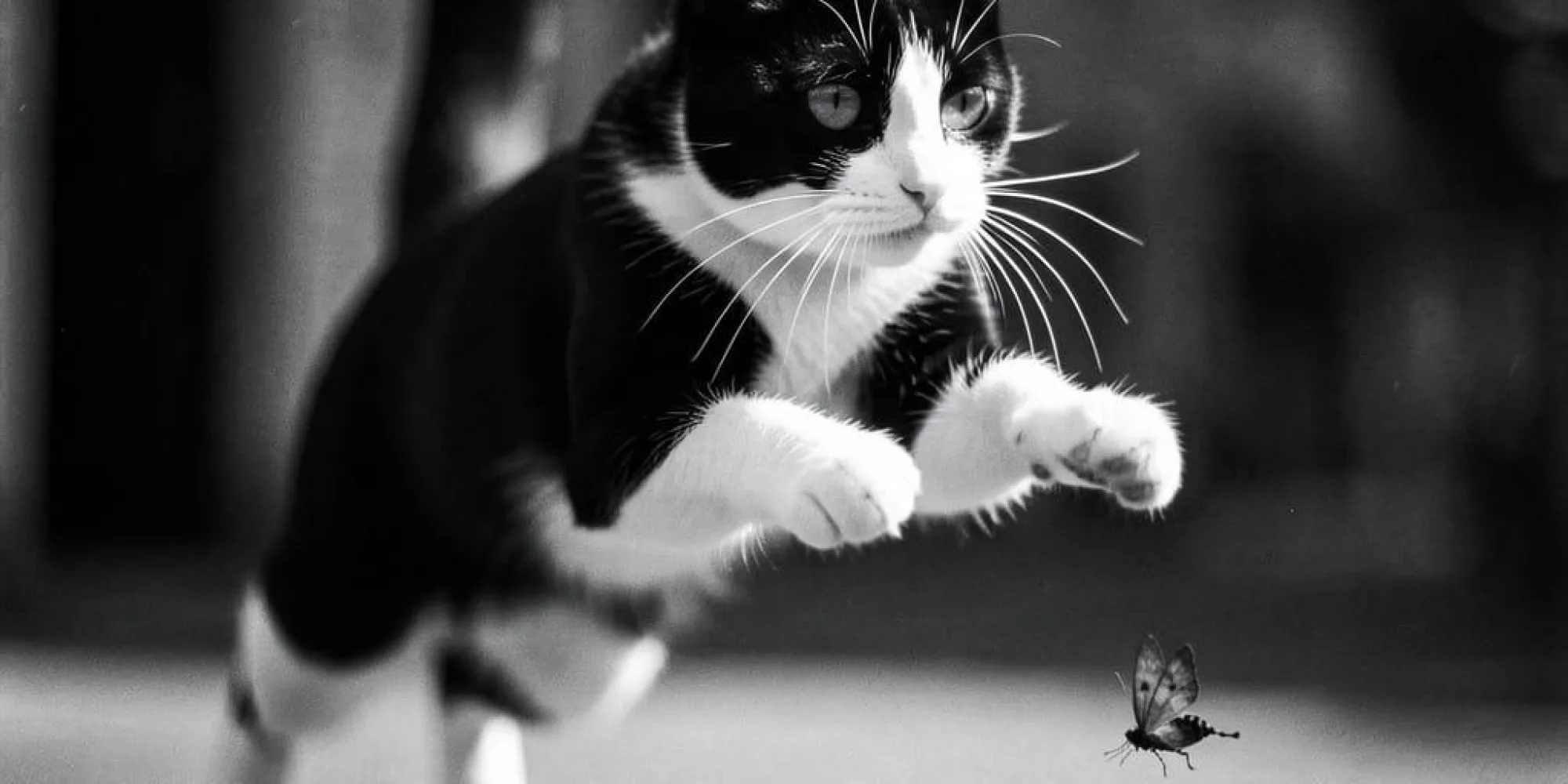
Last night, while winding down with an episode of DCI Banks, Alison’s cat Basil — known in the family as Boo — performed a feat that would make a leopard proud. Out of nowhere, he launched himself in a three metre arc, intercepted a tiny moth one metre above the carpet, pinned it mid air with both paws, ate it, and then walked calmly into the next room as if he’d just collected the electricity bill from the letterbox.
I saw the entire thing in my direct line of sight. I still couldn’t see the moth. Boo could. And Boo won.
In that moment, I realised a human wouldn’t stand a chance if a big cat — leopard, puma, lion — decided we were the main course. Their wiring is ancient, precise, and lethal. Boo is simply the household friendly version of that same operating system.
Two days earlier, the same Boo had run for his life when I tore a sheet of aluminium foil.
Why?
Because Boo’s evolutionary wiring hasn’t caught up with modern noise. To him, the sound of foil isn’t “kitchen activity.” It’s the sound of a giant predatory bird diving with talons out. His nervous system reacts before his brain can interpret. He’s not being silly — he’s being ancient.
Fast forward eight hours.
I’m driving, listening to Dr Anna Lembke talk about dopamine and addiction. Suddenly it clicks: humans are Boo. We are running Stone Age wiring in a world of 7 Eleven counters, bottle shops, smartphones, and infinite digital stimulation.
Our brains were designed for a ten mile walk to find three blueberries, to share them with the tribe, and to feel rewarded by the effort.
Instead, we now stand in front of a wall of chocolate bars engineered for maximum dopamine release, and all we have to do is swipe a piece of plastic 40 cm from our body.
We were built for scarcity. We live in abundance. And abundance is a stressor.
The modern world is an oversupply of dopamine engines: alcohol, drugs, sugar, porn, scrolling, gambling, ultra processed food, formulaic romance novels, likes, notifications, novelty. All cheap. All available. All engineered to bypass effort and deliver instant reward.
Our wiring hasn’t caught up. Just like Boo and the foil.
Boo’s two behaviours — apex predator precision and foil induced panic — aren’t contradictions. They’re the same thing: evolutionary wiring colliding with a modern environment.
Humans are no different.
We are wired for effort, scarcity, movement, natural reward, connection, and meaning. But we live in abundance, convenience, overstimulation, instant gratification, artificial reward, and disconnection.
And that mismatch is one of the root causes of modern addiction.

About Jason Bresnehan
Jason writes in a modular, mind‑drift style that moves between business, recovery, faith, anthropology, and the oddities of everyday life without warning or apology. His work blends operator‑grade clarity with sideways narrative turns — the kind that start in a boardroom, drift through Scripture or Tasmanian riverbanks, and land in a piece of doctrine you didn’t see coming.
He has spent years helping organisations and people get unstuck, and his writing reflects the same instinct: take something messy, name it cleanly, and make it usable. His pieces — whether on addiction, Catholic symbolism, business operators, or human quirks — aren’t lectures. They’re field notes. Observations. Fragments designed for real people in real moments, including the tired executive delayed in an airport lounge at 11:45pm.
Jason publishes micro‑chapters as he writes them — standalone pieces that don’t follow a cadence or a theme. They accumulate over time into a larger body of work, shaped by curiosity, faith, operator discipline, and a refusal to perform — just get outcomes.
Founder of the Hadspen Foundation, Jason is committed to building frameworks for spiritual recovery that are both repeatable and personal. His writing is guided by discernment, narrative cadence, and the belief that doctrine should support—not overshadow—the human story.