
The Tunnel Solution
By any account, Joaquín Archivaldo Guzmán — “El Chapo” — the former drug lord and top leader of the Sinaloa Cartel, was an evil man. He is believed to be responsible for more than 34,000 deaths and was considered the most powerful drug trafficker in the world until he was extradited to the United States and sentenced to life in prison.
He didn’t appear out of nowhere. He rose through the ranks of the drug trade from the 1970s to the 1990s, learning logistics, routes, and distribution from the men who controlled the trade before him. The strange part is how normal the career arc looks: a criminal version of a young accountant grinding late nights under fluorescent lights, slowly climbing the ladder until he becomes the senior international partner of the New York office. Guzmán’s grind began with local marijuana dealers, then with Héctor Luis Palma Salazar, mapping routes into the United States. He later supervised logistics for Miguel Ángel Félix Gallardo, one of the nation’s leading kingpins. When Félix was arrested in 1988, Guzmán founded his own cartel and built a distribution empire that moved cocaine, methamphetamine, marijuana, and heroin into the United States and Europe. His real innovation was simple: distribution cells and long‑range tunnels. With those two ideas, he exported more drugs into the United States than any trafficker in history.
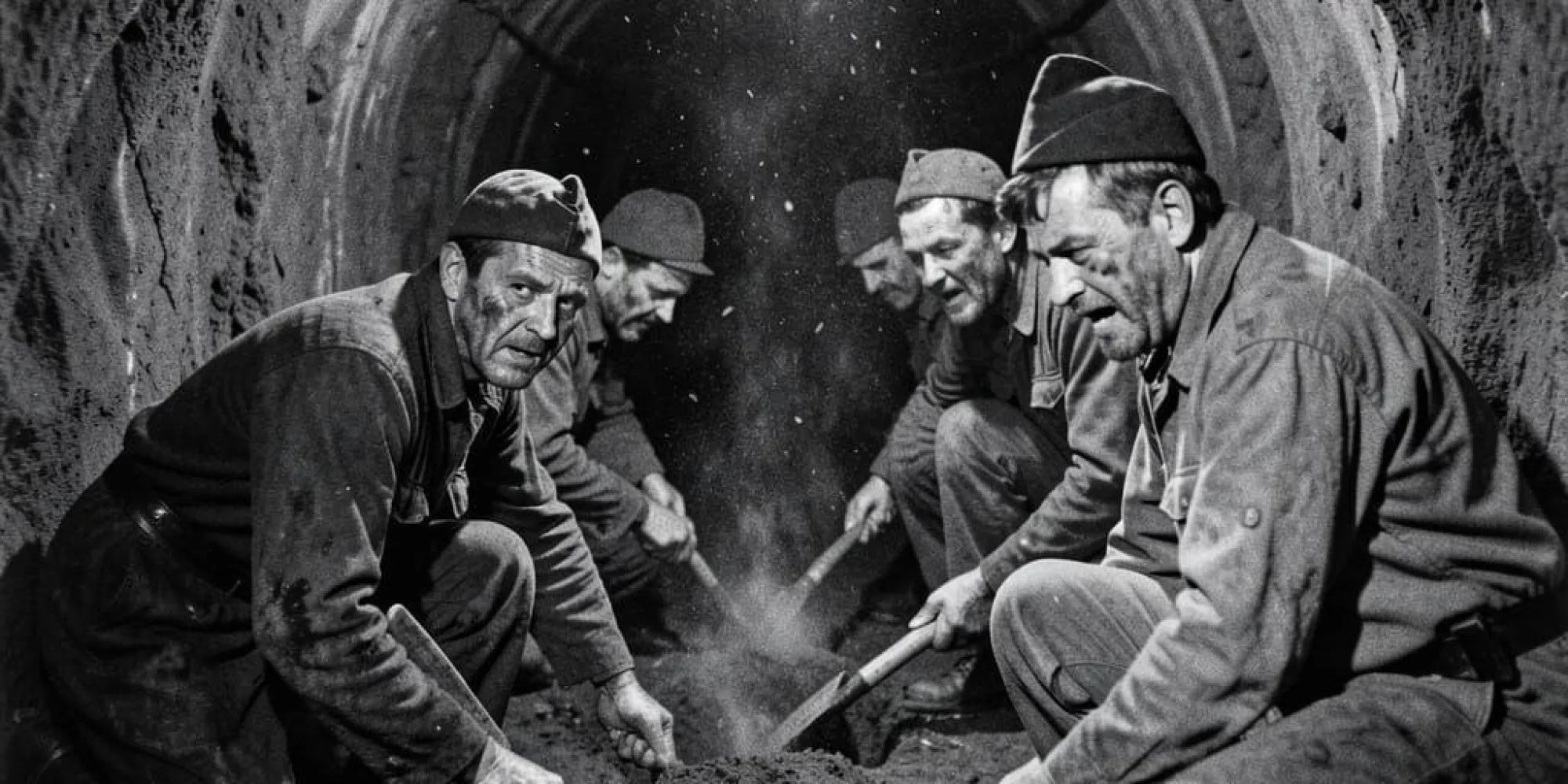
That got me thinking about tunnels and how long they’ve been used. When the early Church was under threat, clergy slipped through stone passages carved beneath monasteries and cathedrals. They weren’t elaborate. They weren’t engineered with precision. They were just holes in the ground that let people disappear when the surface became dangerous. The same logic reappeared in every century that followed. When the world was on fire in the 1940s, POWs dug their way out of camps with spoons and tin cans, moving dirt in their pockets, building escape routes under the boots of guards who thought they had total control. Hogan’s Heroes turned it into comedy, but the tactic was real. When the surface is controlled, go under it.
The tunnel solution shows up in fiction because it’s so deeply human. The Shawshank Redemption is built on the same idea: the system is too big, too rigid, too fortified, so the only way out is through the wall, one handful of dust at a time. It’s not a metaphor. It’s a pattern. When the world becomes too complex, the simplest path becomes the only viable path.
Tunnels had a place in my imagination too. Like most kids, I loved the idea of tunnels between sofa‑cushion forts. Later, at about thirteen, my friends and I used to play spotlight. One night, instead of running around like everyone else, I went out with two kids on my team, found a sheet of plywood, dug a hole big enough for us to sit in, laid the plywood over the top, and covered it with dirt, bark, and ferns. We slipped into the hole and waited. At one point a kid was literally standing on the roof of the hole, and we didn’t move, didn’t breathe, didn’t get found. It was so effective they had to change the rules to ban holes. They were playing the visible game. We changed the terrain.
That’s the tunnel solution. Everyone else is looking for speed, light, noise, movement, high‑tech answers. Meanwhile the winning move is a hole in the ground with a bit of plywood on top.
The tunnel solution is the reminder that the simplest ideas are often the most effective, not because they are clever, but because they bypass the assumptions everyone else is trapped inside. People get hypnotised by complexity. They fall in love with surface thinking — the belief that the visible layer is the only layer. They assume the biggest problem requires the biggest solution. But sometimes the answer is older than the problem. Sometimes the answer is so simple it becomes invisible. Sometimes the answer is a tunnel.
And then you see tunnels again in the 1990s, using the same structural logic, this time to smuggle billions of dollars’ worth of illicit drugs from Mexico into the largest economic power in the world, the United States. A global superpower with satellites, drones, sensors, radar, thermal imaging, and a trillion‑dollar security apparatus couldn’t stop El Chapo’s men from digging a tunnel under a border. Not because he was a genius. Not because he had special technology. Not because he had mystical insight. He had extension cords, floodlights, ventilation fans, and the same idea the early Church used two thousand years earlier. The same idea POWs used in WWII. The same idea I used as a kid hiding under a sheet of plywood. When the system is too complex, go simple. When the opponent is too powerful, change the dimension of the fight.
The tunnel solution is not about tunnels. It’s about refusing to be hypnotised by complexity. It’s about remembering that the oldest ideas survive because they work. It’s about stepping outside the frame everyone else is trapped inside. It’s about looking down when everyone else is looking up. It’s about understanding that the simplest path is often the one nobody sees because they’re too busy staring at the machinery.
Some problems don’t need a breakthrough. They need a hole in the ground. Some systems don’t need to be confronted. They need to be bypassed. Some obstacles don’t need to be fought. They need to be stepped around. If you’re fighting the system head‑on, you’ve already accepted its rules. The tunnel solution is how you leave the game without asking permission.

About Jason Bresnehan
Jason writes in a modular, mind‑drift style that moves between business, recovery, faith, anthropology, and the oddities of everyday life without warning or apology. His work blends operator‑grade clarity with sideways narrative turns — the kind that start in a boardroom, drift through Scripture or Tasmanian riverbanks, and land in a piece of doctrine you didn’t see coming.
He has spent years helping organisations and people get unstuck, and his writing reflects the same instinct: take something messy, name it cleanly, and make it usable. His pieces — whether on addiction, Catholic symbolism, business operators, or human quirks — aren’t lectures. They’re field notes. Observations. Fragments designed for real people in real moments, including the tired executive delayed in an airport lounge at 11:45pm.
Jason publishes micro‑chapters as he writes them — standalone pieces that don’t follow a cadence or a theme. They accumulate over time into a larger body of work, shaped by curiosity, faith, operator discipline, and a refusal to perform — just get outcomes.
Founder of the Hadspen Foundation, Jason is committed to building frameworks for spiritual recovery that are both repeatable and personal. His writing is guided by discernment, narrative cadence, and the belief that doctrine should support—not overshadow—the human story.