
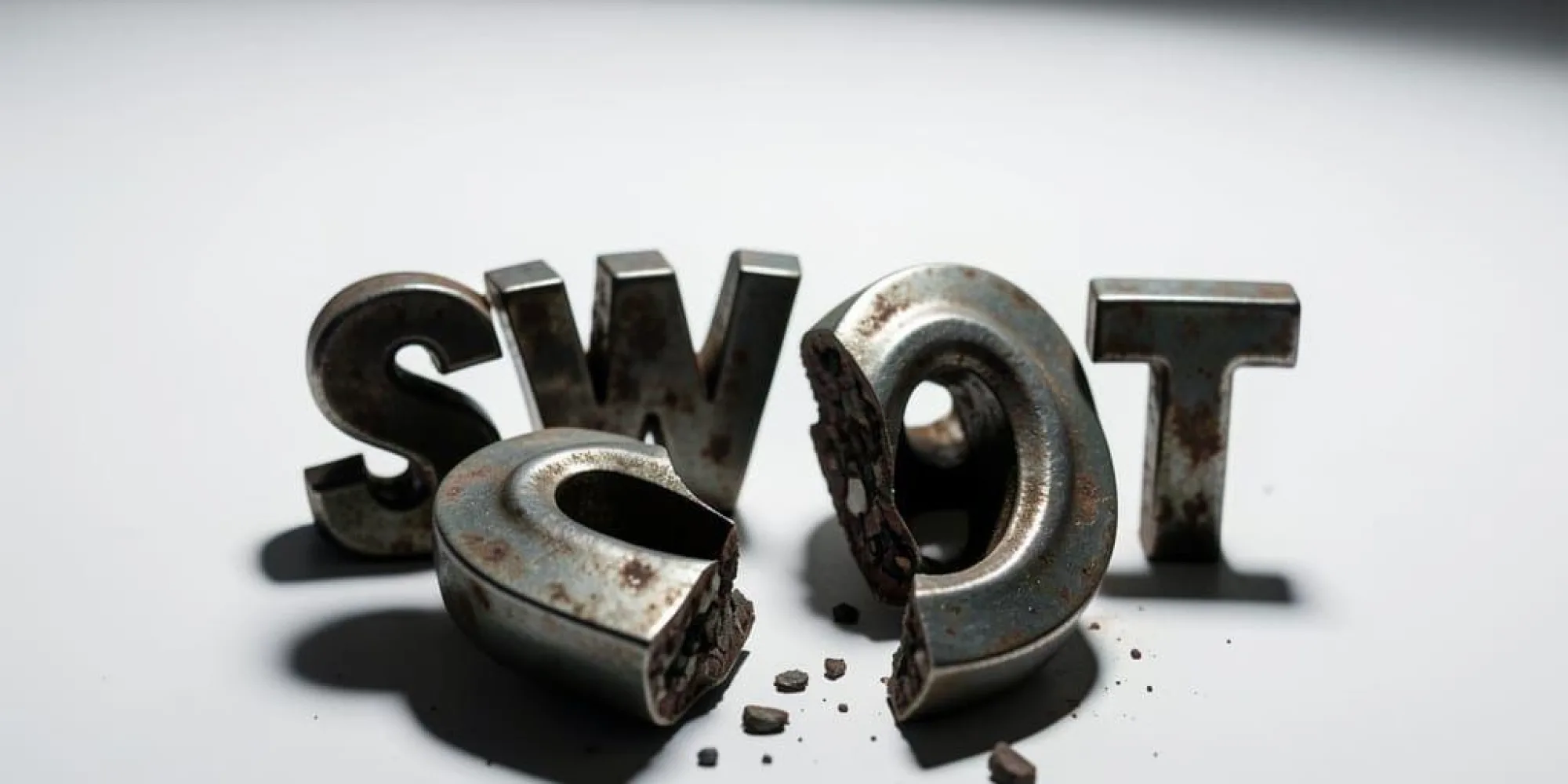
The Real 'O' in SWOT
SWOT is one of the most widely used strategic tools in the world and also one of the most widely misunderstood. It appears in boardrooms, business plans, school assignments, leadership retreats, and corporate off‑sites covered in butcher’s paper and coloured markers, yet very few people know where it came from and even fewer know how to use it properly.
SWOT is commonly traced back to work conducted in the 1960s at the Stanford Research Institute, where researchers were studying why corporate planning kept failing. At the time, the framework was known as SOFT analysis, standing for Satisfactory, Opportunity, Fault, and Threat. Over time, it evolved into the four‑quadrant model now familiar to almost everyone. What mattered then, and still matters now, was not the labels but the problem the researchers were trying to solve.
They discovered that organisations were repeatedly confusing internal factors with external ones, and that this confusion was leading to serious strategic errors. Leaders were treating market conditions as if they were internal capabilities, and internal weaknesses as if they were external obstacles. The solution was a simple structure that forced a clean separation between what could be controlled and what could not. Strengths and Weaknesses were defined as internal. Opportunities and Threats were defined as external. Two internal and two external, with perfect symmetry. That was the original architecture. That was the version that worked. That is also the version that has largely been lost.
Before going any further, it is worth addressing the reader who is already starting to disengage because business frameworks tend to induce boredom or suspicion. SWOT may have been born in a business context, but it is not a business tool in the narrow sense. Once understood properly, it applies to athletes seeking performance gains, to actors navigating uncertain careers, to people in addiction recovery attempting to stabilise their lives, and to anyone making difficult decisions in relationships or life more broadly. In every domain where growth, movement, or improvement matters, the same internal and external forces are at play. SWOT works in all of those settings, but only when each quadrant is understood for what it actually represents.
In business, Strengths are the internal capabilities that already exist within the organisation. They are the things that can be deployed immediately without permission from the outside world. A strong balance sheet, a skilled workforce, a reputation for reliability, a patented process, or a loyal customer base qualify as Strengths because they live inside the business and are available in the present tense. They are not aspirations, future goals, or things the organisation hopes to become. They are resources and assets that already exist.
In sport, Strengths are the internal attributes an athlete brings to competition every time they step onto the court or field. These include physical characteristics such as height, wingspan, athleticism, and endurance, as well as less visible but equally decisive elements such as the ability to read play before it unfolds, emotional regulation under pressure, training discipline, reputation in the locker room, and comfort in one’s own identity. Even spiritual or moral anchor points that keep an athlete steady in high‑noise environments belong in this category. These qualities may not appear on a stat sheet, but they shape performance as reliably as technique or conditioning.
Once Strengths are understood as internal, present, and already possessed, the structure of the model becomes clearer. Strengths and Weaknesses form the internal architecture of a person or organisation. They represent what exists inside, what can be controlled, developed, compensated for, or deployed. They define the internal reality that will eventually collide with the external world.
In business, Weaknesses are the internal limitations that already exist within the organisation. They are the gaps, constraints, and vulnerabilities that slow progress or increase risk. Outdated systems, limited capability, shallow leadership depth, high staff turnover, inconsistent processes, or a fragile balance sheet qualify as Weaknesses because they live inside the organisation. They are uncomfortable to acknowledge, but they remain within the organisation’s sphere of control.
In basketball, Weaknesses are the internal limitations an athlete carries with them into every game. These may include an injury history that affects recovery, a body that no longer responds the way it once did, the reality of aging in a league designed for younger players, declining speed or explosiveness, a prolonged loss of confidence, poor decision‑making under pressure, or a gradual shift of attention toward off‑court pursuits that begin to compete with performance priorities. These are Weaknesses because they originate inside the athlete’s body, mind, or identity. They are not caused by the crowd, the coach, or the opposition. They are simply internal constraints that shape what is possible.
Strengths and Weaknesses together define the internal structure. They are not moral judgments or excuses. They are descriptions of reality. They determine how well a person or organisation is equipped to meet what comes next.
Before turning to Opportunities, it is necessary to deal with Threats, because this is where most people feel most comfortable. Across decades of delivering strategic workshops in boardrooms, and later delivering the same framework in addiction recovery settings, the pattern remains consistent. People find it far easier to name what is working against them than what is working for them. Threats are vivid, concrete, and emotionally charged. They are also external, and that distinction matters.
Threats are forces in the environment that can harm, destabilise, pressure, or close off options. They are not chosen or controlled. They arrive regardless of preparation or intent.
In business, Threats include external pressures such as technological disruption, competitors with greater resources, tightening labour markets, rising interest rates, inflation, shrinking access to capital, regulatory overreach, demographic shifts, or systemic underfunding in critical sectors. These forces originate outside the organisation and exert pressure on it. They cannot be negotiated with or ignored. They can only be responded to.
In sport, Threats are equally external. A younger and more physically dominant draft pick entering the league, a new defensive scheme that neutralises existing strengths, a coaching change that alters rotation preferences, or a competitive environment that increasingly favours different skill sets all qualify. These forces are not internal failings. They are features of the environment.
In addiction recovery, external Threats are often relentless. Social circles that remain entrenched in substance use, environmental triggers that are impossible to avoid, housing instability, limited access to support services, destabilising family dynamics, seasonal depression, and media cycles that amplify anxiety all exert pressure from the outside. These are not moral weaknesses or character flaws. They are environmental realities that shape the path ahead.
Threats are the easiest quadrant to understand because they are visible and tangible. They are the forces pressing in from the outside. Strengths and Weaknesses live inside. Threats live outside. Internal structure meets external pressure. At this point, the architecture begins to make sense.
It is in the Opportunities quadrant that the model is most commonly misunderstood. Somewhere along the way, Opportunities were transformed into aspirational slogans detached from their original meaning. They became placeholders for hope, ambition, or motivational language rather than descriptions of external reality. Phrases such as increasing sales, improving leadership, or becoming more innovative began to appear where Opportunities should have been. These are not Opportunities. They are internal goals, and placing them in the external quadrant breaks the model.
Years of facilitating strategic workshops reveal the same pattern. After a break, refreshed participants return and quickly revert to treating Opportunities as wish lists rather than environmental openings. Even when the external nature of Opportunities has been explained clearly, the temptation to smuggle aspirations into that quadrant persists. This is why the O in SWOT requires rescuing. It has been overtaken by wishful thinking and corporate optimism, but when stripped back to its original definition, it regains its power.
Opportunities are external forces or conditions that open a path. In business, they include events such as a competitor collapsing, a new market emerging, supplier pricing shifting, a distribution channel expanding, a regulatory change creating space, or a new technology becoming available for adoption. These forces originate outside the organisation. They are not created internally, and they cannot be summoned by intention alone. They appear, and they can either be stepped into or missed.
In sport, Opportunities also arise externally. An injury to a starting player that opens a rotation spot, a coaching change that favours a particular style of play, a rule adjustment that amplifies certain skills, or a sponsorship offer that arrives because of reputation rather than performance all qualify. These are environmental openings that can be leveraged into improved outcomes.
In recovery, Opportunities are often decisive. A rehabilitation bed becoming available, safe housing opening up, improved transport access, the formation of a new support group, employment arising due to someone else’s departure, or a stabilising family presence returning to town can all create movement. These openings are not generated by willpower or personal growth alone. They exist in the environment and alter what becomes possible.
Once Opportunities are restored to their external meaning, the final and most important insight of the model becomes visible. Opportunities and Threats are not opposites. They are not good and bad. They are not positive and negative. They are the same class of external force. The only difference between them is how they interact with internal structure.
An Opportunity is not automatically beneficial, and a Threat is not automatically destructive. The same external event can elevate or destroy depending entirely on internal Strengths and Weaknesses. A new dealership becoming available can be a ladder or a trap. A new technology can create advantage or trigger obsolescence. A new market can fuel growth or accelerate collapse. External forces do not carry moral intent. They simply exist.
In high‑risk environments such as aviation, emergency services, frontline medicine, elite sport, or addiction recovery, this distinction becomes especially sharp. Sudden promotions, new responsibilities, job offers, relationships, relocations, or treatment openings can stabilise or destabilise. If internal structure is ready, the opening lifts performance. If it is not, the same opening exposes weakness.
External forces do not care about intention, identity, or narrative. They do not respond to hope, belief, or effort alone. They meet internal reality where it stands. Strengths and Weaknesses determine the outcome.
When this is understood, SWOT stops being a worksheet and becomes what it was always meant to be. It becomes a way of seeing reality clearly, of understanding how internal capability meets external environment, and of navigating movement without illusion. Strengths and Weaknesses are internal. Opportunities and Threats are external. That symmetry is the spine of the model. Break it, and SWOT collapses into wishful thinking. Restore it, and the model comes back to life. That is the Real O in SWOT.

About Jason Bresnehan
Jason writes in a modular, mind‑drift style that moves between business, recovery, faith, anthropology, and the oddities of everyday life without warning or apology. His work blends operator‑grade clarity with sideways narrative turns — the kind that start in a boardroom, drift through Scripture or Tasmanian riverbanks, and land in a piece of doctrine you didn’t see coming.
He has spent years helping organisations and people get unstuck, and his writing reflects the same instinct: take something messy, name it cleanly, and make it usable. His pieces — whether on addiction, Catholic symbolism, business operators, or human quirks — aren’t lectures. They’re field notes. Observations. Fragments designed for real people in real moments, including the tired executive delayed in an airport lounge at 11:45pm.
Jason publishes micro‑chapters as he writes them — standalone pieces that don’t follow a cadence or a theme. They accumulate over time into a larger body of work, shaped by curiosity, faith, operator discipline, and a refusal to perform — just get outcomes.
Founder of the Hadspen Foundation, Jason is committed to building frameworks for spiritual recovery that are both repeatable and personal. His writing is guided by discernment, narrative cadence, and the belief that doctrine should support—not overshadow—the human story.