
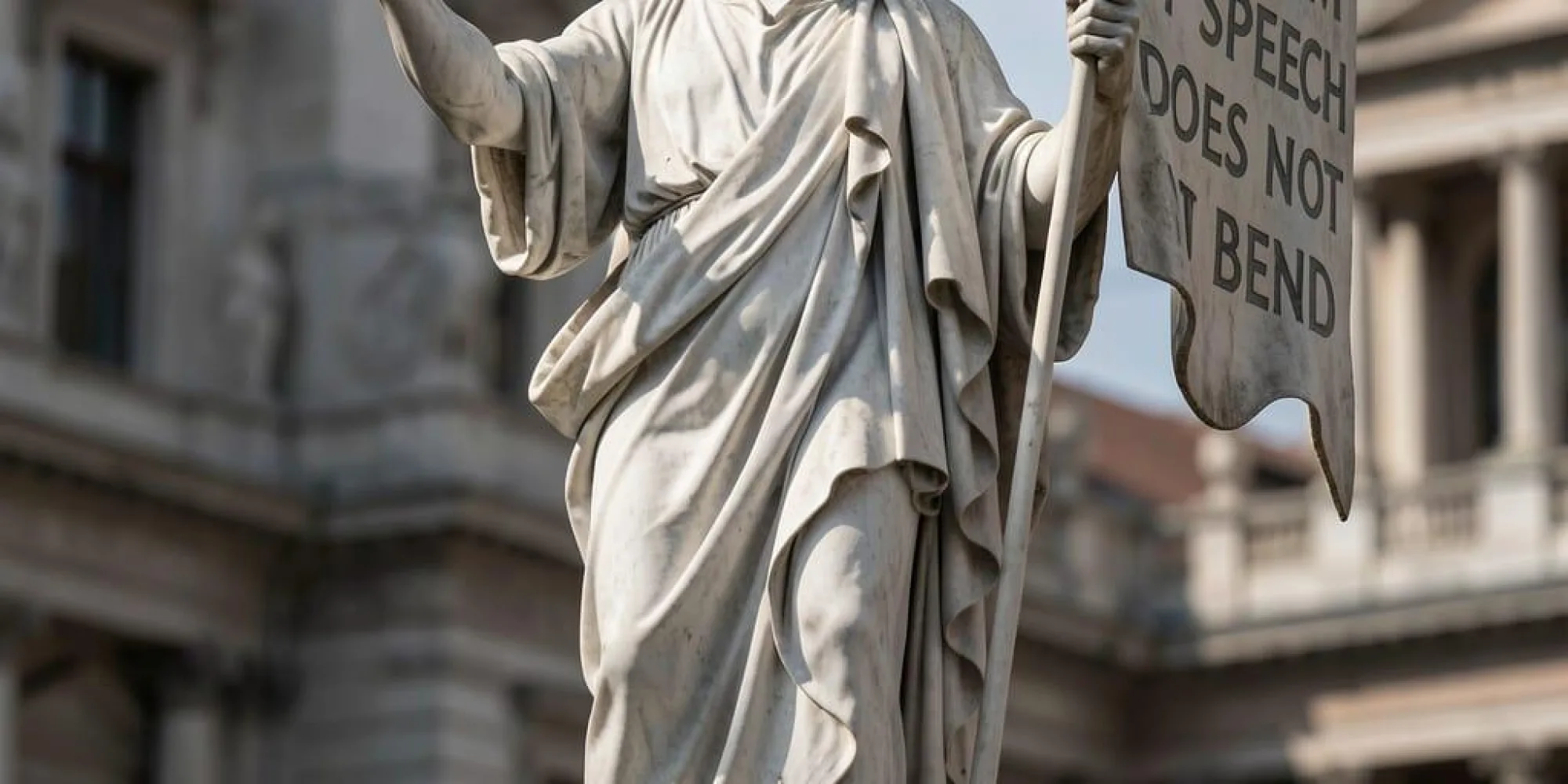
The Principle That Doesn't Bend
Freedom of speech is one of those principles that refuses to scale down. It doesn’t come in half‑strength or low‑impact versions. It is either upheld in full or it is not upheld at all. The moment you try to soften it, you have already replaced it with something else.
It carries a cost. Words can bruise. Ideas can sting. People can be careless, clumsy, or unkind. But the hurt is temporary, and it belongs to the surface of life, not its structure. The structure is what matters. A society that absorbs the discomfort of speech is a society that keeps its deeper freedoms intact.
The danger is never the loud voice. It is the quiet hand that decides which voices may speak. Once someone is given the authority to filter, soften, or approve expression, the slope is already tilting. Not because of malice, but because power always expands to fill the space it is given. What begins as protection becomes permission. What begins as permission becomes control.
The slope is real because human nature is real. We drift toward safety, and then toward certainty, and then toward the comfort of having someone else decide what should be said. But the soul contracts under that arrangement. It loses its range. It forgets how to disagree, how to withstand, how to stand.
Freedom of speech is not a courtesy. It is a discipline. It asks us to hold steady in the presence of discomfort so that the deeper freedoms — thought, conscience, belief, imagination — remain untouched. It is the price we pay to keep the interior world ungoverned.
You cannot be a little bit free. You either are, or you are not

About Jason Bresnehan
Jason writes in a modular, mind‑drift style that moves between business, recovery, faith, anthropology, and the oddities of everyday life without warning or apology. His work blends operator‑grade clarity with sideways narrative turns — the kind that start in a boardroom, drift through Scripture or Tasmanian riverbanks, and land in a piece of doctrine you didn’t see coming.
He has spent years helping organisations and people get unstuck, and his writing reflects the same instinct: take something messy, name it cleanly, and make it usable. His pieces — whether on addiction, Catholic symbolism, business operators, or human quirks — aren’t lectures. They’re field notes. Observations. Fragments designed for real people in real moments, including the tired executive delayed in an airport lounge at 11:45pm.
Jason publishes micro‑chapters as he writes them — standalone pieces that don’t follow a cadence or a theme. They accumulate over time into a larger body of work, shaped by curiosity, faith, operator discipline, and a refusal to perform — just get outcomes.
Founder of the Hadspen Foundation, Jason is committed to building frameworks for spiritual recovery that are both repeatable and personal. His writing is guided by discernment, narrative cadence, and the belief that doctrine should support—not overshadow—the human story.