
The Parmesan Epiphany
I sliced off a piece of pecorino Romano tonight — the good stuff, the Italian-made block with the hard edges and the smell that tells you it has a lineage. The moment it hit my tongue, something in my memory snapped open like a door I hadn’t walked through in twenty years.
I was suddenly back in Milan.
Austrade cocktail function. High ceilings. Polished marble. A small cluster of Australians doing what Australians do overseas — trying to look like we belonged while quietly checking the exits.
Then the waiter arrived.
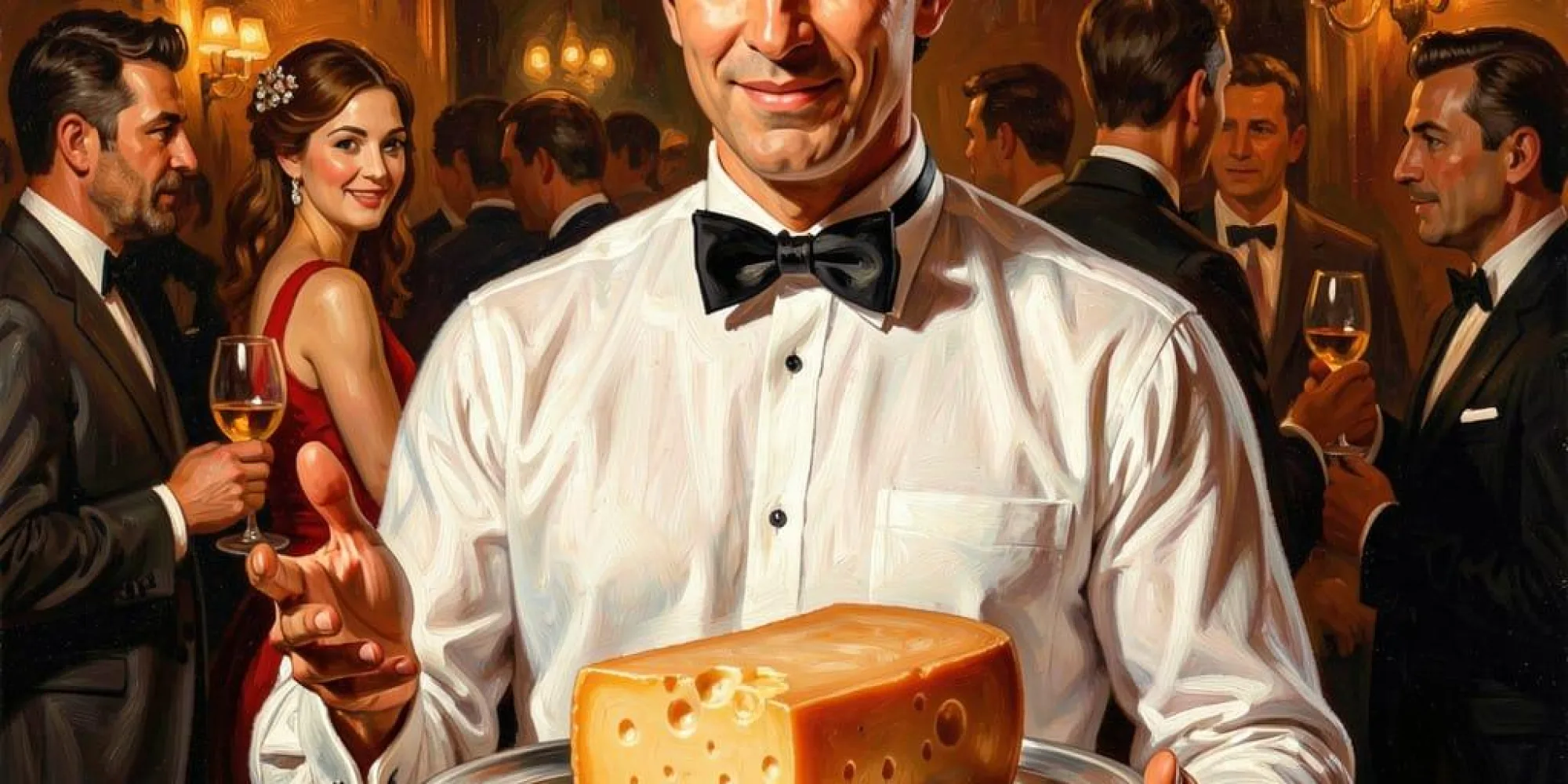
Black-and-white suit. Bow tie. Linen napkin draped over his non‑serving arm with the kind of precision that suggested he’d ironed it himself. He carried a silver tray with nothing on it but slices of Parmesan. Not shaved. Not grated. Not paired with anything. Just unapologetic slabs of cheese, cut thick enough to have weight.
I had never seen Parmesan served that way. Parmesan, in my world, was something you sprinkled on pasta or shook out of a green can. But when in Milan, you do as the Milanese do, so I took a slice.
The taste was extraordinary — sharp, ancient, alive. But even as it hit my palate, another thought hit me harder:
Was the cheese really that good?
Or was I tasting the delivery?
Because the waiter didn’t just hand me cheese. He presented it with a look that said, without a single word:
“This will be the best piece of Parmesan you will ever taste in your short, unfulfilled life. This is Parmesan from the epicentre — from the soil and the hands that have been making it longer than your country has existed. You are fortunate to even be in the same room as this cheese.”
And I believed him.
Not because he sold it.
Because he embodied it.
He moved with the certainty of someone who knew exactly what he was carrying — six centuries of craft, discipline, and identity. He didn’t need to explain it. He didn’t need to justify it. He didn’t need to perform.
He was simply the vessel through which the identity of the cheese travelled.
And that’s why it tasted the way it did.
Tonight, as the pecorino hit my tongue, I realised the truth:
It tasted so good because I was consuming an unapologetic identity 900 years old.
And maybe that’s the whole point — that anything delivered with that level of certainty, lineage, and self‑possession becomes unforgettable.

About Jason Bresnehan
Jason writes in a modular, mind‑drift style that moves between business, recovery, faith, anthropology, and the oddities of everyday life without warning or apology. His work blends operator‑grade clarity with sideways narrative turns — the kind that start in a boardroom, drift through Scripture or Tasmanian riverbanks, and land in a piece of doctrine you didn’t see coming.
He has spent years helping organisations and people get unstuck, and his writing reflects the same instinct: take something messy, name it cleanly, and make it usable. His pieces — whether on addiction, Catholic symbolism, business operators, or human quirks — aren’t lectures. They’re field notes. Observations. Fragments designed for real people in real moments, including the tired executive delayed in an airport lounge at 11:45pm.
Jason publishes micro‑chapters as he writes them — standalone pieces that don’t follow a cadence or a theme. They accumulate over time into a larger body of work, shaped by curiosity, faith, operator discipline, and a refusal to perform — just get outcomes.
Founder of the Hadspen Foundation, Jason is committed to building frameworks for spiritual recovery that are both repeatable and personal. His writing is guided by discernment, narrative cadence, and the belief that doctrine should support—not overshadow—the human story.