
The Heist That Broke the Belgians
I recently watched Stolen: The Antwerp Diamond Heist, and it’s a documentary with a very simple lesson: imagination, flair and style beat normal, routine and rigidity every single time.
Agim, a former commander of the Belgian Federal Police Diamond Squad, outlines the case for “boring” in the first fifteen seconds. Delivered in the flat, robotic cadence of a man speaking his second language while wearing a too‑tight uniform, he recounts the first twenty minutes of their sleuthing.
It was a “normal” Monday morning, with a lead on a “normal” man.
“I arrived at the office,” he says, “most of the time we start with a cup of coffee, but I saw Patrick sitting there ready to leave — I said, ‘oh, no time for a coffee, Patrick.’”
His inflection — that little “ohp” — is the sound of a man whose internal compass has just spun.
A tiny tremor.
A hairline crack in the Belgian monastic routine.
But the aftershocks keep rolling.
Patrick replies, “I don’t think so.”
Not brisk.
Not practical.
Not “we’re running late.”
It’s pained.
It’s heavy.
It’s the tone of someone delivering devastating news gently, like:
• “I don’t think you have a job anymore.”
• “I don’t think the test results are good.”
Patrick isn’t saying they’re busy.
He’s saying the ritual is broken.
And in Antwerp, when the ritual breaks, everything breaks.
This is the emotional aftershock of the heist — the moment the detectives feel, viscerally, that the system they trusted was never as strong as they believed.
I could see instantly where this documentary was going.
It was the rigid, ritualistic, almost monastic features of the Belgian system that allowed US$300 million of diamonds to seemingly disappear into thin air on this “normal” Monday morning.
And sadly, Agim and Patrick still don’t know they’re the butt of the joke.
I’m sure when they watched themselves back on a big screen, they only contemplated whether their collars were correctly starched and prayed there wasn’t lint on their jackets — because that would be most unbecoming for a Federal Police Commander.
My mind started racing.
In any compelling, high‑stakes story, the protagonists must be the exact opposite of our rule‑loving Agim and Patrick.
Who could they be?
Surely not larrikin Australians or stylish Ocean’s‑11 Americans — no chance. Australians or a ragtag American heist crew would stand out in Antwerp, the global city for diamond trading, just like a detective from Antwerp would stand out in an outback pub or a Nashville recording studio.
It couldn’t be.
Well, I only had to wait a few more minutes for the answer.
Who are the most imaginative, confident, stylish, flamboyant Europeans?
The Italians, of course.
It made perfect sense.
They could pass as “normal” in a $6,000 Armani suit as long as they stayed unanimated during the reconnaissance stage.
And that’s exactly what they did — this ragtag group of Italians, the least rigid Europeans alive, danced through an Antwerp security system built like a spreadsheet.
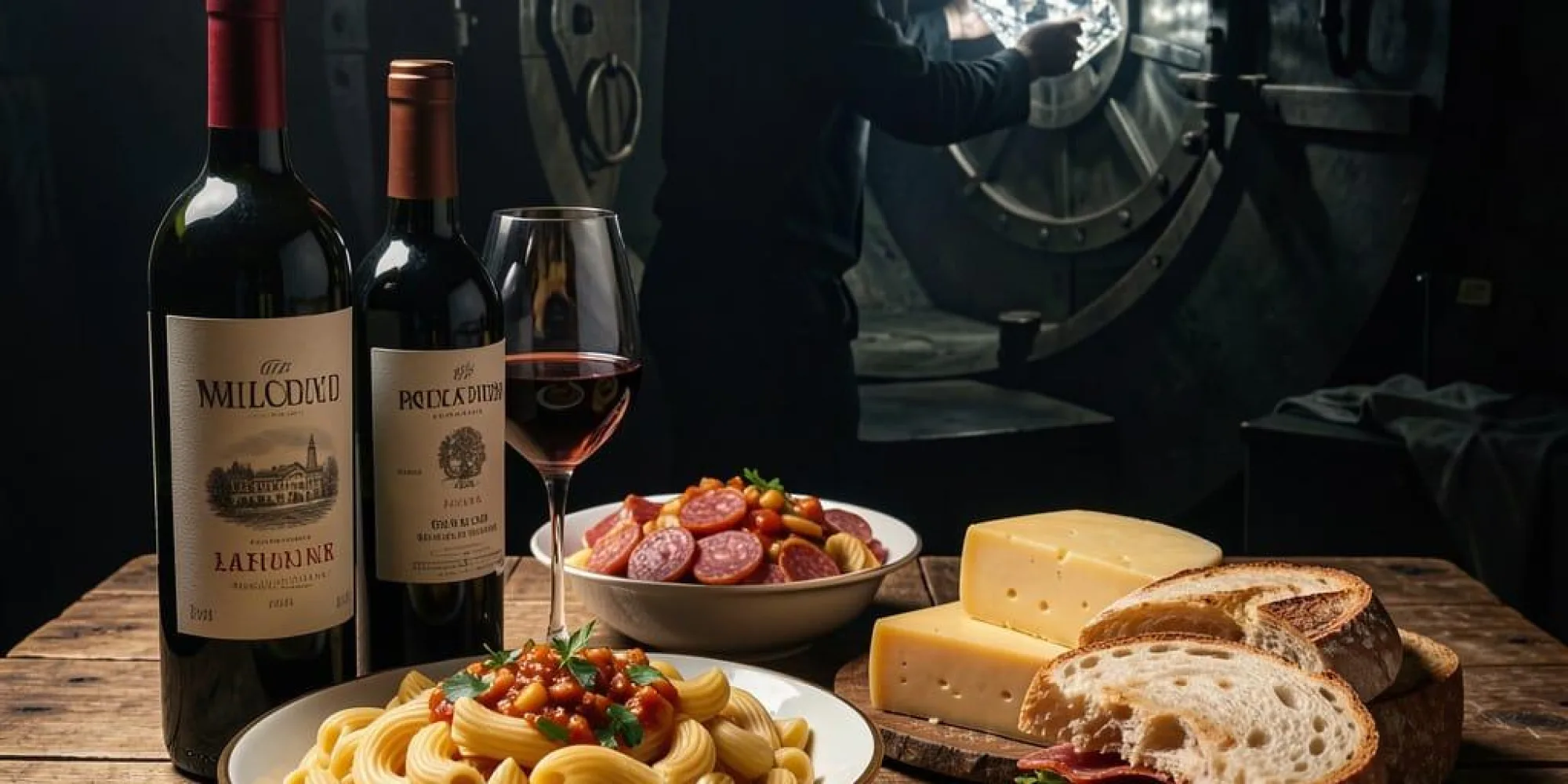
Wine, Cheese, Pasta, a Half‑Eaten Salami Sandwich and… Porn
The first clue came when a small store owner living on the edge of the woods beside the highway out of Antwerp went to feed food scraps to the rabbits and fish. He discovered trash on the roadside: hundreds of gemstone bags, paperwork about diamonds, a few small emeralds, some banknotes, and a scrambled mess of VHS tape.
Annoyed because his routine of talking to the rabbits had been interrupted, he returned home angry and called the police.
Agim and Patrick thought they were onto something.
What caught their eye among the wine, cheese, pasta, the half‑eaten salami sandwich, the gemstone bags, the paperwork and the discarded emeralds was the loose VHS tape — because the Diamond Centre’s security tapes for Saturday and Sunday were missing.
The tape was rushed to Sony HQ with urgent Federal Police business to “put it back together.”
And the Sony technicians did their job — apparently without watching the tape they had just reassembled.
Agim and Patrick gathered the entire team around the TV and pressed play.
This was to be the big reveal.
The thieves’ identities would be known.
Instead, all that was revealed was that our Italian thieves had a great sense of humour.
They had branded their heist not with a Sinaloa‑Cartel‑style scorpion stamp, but with wine, cheese, pasta, a half‑eaten salami sandwich… and porn.
Patrick, almost catching onto the theme that Belgian rigidity was the problem, delivered a pearler:
“I’d never been so disappointed in a porn movie as I was then.”
At this point, my mind affectionately drifted to a client I was handed as an 18‑year‑old accountant. I was working at a stuffy firm with a clientele of landed‑gentry bluebloods who had inherited large Tasmanian pastoral holdings because their grandfather had good horse‑riding skills. What they could ride around in a day on Van Diemen’s Land (now Tasmania), they were granted by the Crown.
But this client was not one of them. This client was Novaro Alberto Taurian.
Novaro had met Enzo Ferrari, been a pheasant farmer, a restaurateur, and now a cheesemaker. He collected Beretta shotguns and educated me that Italians make the best textiles, the best suits, the best parmesan, the best cars and wine. They have the best women and grow the best tomatoes, olives and artichokes.
Italians don’t make good bookkeepers, however.
Novaro was too hot to handle and couldn’t really afford the firm’s bills because he was still recovering from a crazy 1% Swiss‑franc loan — which was good until the Australian dollar tanked and the 1% loan became about 60%.
So the firm green‑lit me to moonlight for Novaro, which I did on Saturday mornings, where I learned to start drinking wine at 10:45am and how to cook a slow‑reduced pasta sauce with San Marzano tomatoes, olive oil, sliced garlic and basil.
Watching the documentary, I realised:
of course the thieves were Italian.
This was Novaro energy, weaponised.
Leonardo and His Script Changes
The porn tape was a blow, but the dots were joining.
There was their “normal” looking man: Leonardo — once a formally legitimate diamond trader — who had rented a tiny office in the Diamond Building. It wasn’t a workplace so much as a posture move, a way to impress clients. He was rarely there. Most of his real business happened back in his jewellery shops in Italy.
Eighteen months before the heist, a stranger named Alessandro approached him with the offer:
“Are you in for fifteen million?
We need your office and your access to the vault.”
Leonardo had a security box in that vault, so he moved in and out often enough to be invisible.
And he didn’t hesitate.
He didn’t negotiate.
He didn’t ask for details.
I could be accused of making emotional decisions from time to time, but Leonardo’s reply relegated me to the junior leagues:
“Yes. I have always wanted to be part of something like this.”
That’s not criminality.
That’s an Italian man finally being invited into the movie he’s been watching in his head since childhood.
A year before the heist, Alessandro took him to an industrial warehouse in Turin — sparks flying from an angle grinder, concrete dust in the air, the whole scene lit like a low‑budget crime film. This is where he met the crew.
There were three men. Alessandro introduced them with fake names, but Leonardo — fully in movie‑mode — rejected them immediately. He gave them his own.
1. The Monster — the tall, well‑built, pretty‑boy who looked like a movie star.
2. The Genius — the short, half‑hacker, half‑computer‑nerd who could make anything electronic obey.
3. The Key Master — the thug‑looking but quietly spoken man who could get through any lock on earth.
Only once the names were right — once the cast list matched the film in his head — was Leonardo satisfied.
He wasn’t joining a heist.
He was approving the script.
A Fire Extinguisher, The Sabbath, Precision‑Machined Allen Keys and Hairspray
In the build‑up to go‑time, reconnaissance continued.
There were no Google Glasses or Meta Ray‑Bans back then, so The Monster fitted a small VHS camcorder into a fire extinguisher. Leonardo went in with a shoulder bag with another VHS lens poking out the bottom, feigning — very poorly — a bad back while stretching around the vault room trying to capture the ceiling sensors.
He was interrupted by a security guard asking if he was okay.
The bad‑back story held.
And now it was the day of the heist.
They chose a Saturday.
The key players in the Antwerp diamond trade are Jewish, so it was a no‑brainer — the building would be empty.
The precision‑machined Ikea‑style Allen key fitted the garage door perfectly.
They used hairspray to block a sensor — a €3 can defeating millions of euros of hardware.
Patrick, in his interview, is still insisting about the camera in the fire extinguisher:
“It’s not possible. It’s not the movies.”
But it is possible.
And they did it.
And the footage exists.
This isn’t analysis.
It’s denial.
The Belgians can’t accept that imagination beat procedure.
That improvisation beat routine.
You need to watch the rest of the documentary to see how it all works out for Leonardo, Alessandro, The Monster, The Genius and The Key Master — but honestly, as good yarns go, the story could stop here.
Because it’s already a rocking good tale about imagination executed with style beating routine executed robotically.

About Jason Bresnehan
Jason writes in a modular, mind‑drift style that moves between business, recovery, faith, anthropology, and the oddities of everyday life without warning or apology. His work blends operator‑grade clarity with sideways narrative turns — the kind that start in a boardroom, drift through Scripture or Tasmanian riverbanks, and land in a piece of doctrine you didn’t see coming.
He has spent years helping organisations and people get unstuck, and his writing reflects the same instinct: take something messy, name it cleanly, and make it usable. His pieces — whether on addiction, Catholic symbolism, business operators, or human quirks — aren’t lectures. They’re field notes. Observations. Fragments designed for real people in real moments, including the tired executive delayed in an airport lounge at 11:45pm.
Jason publishes micro‑chapters as he writes them — standalone pieces that don’t follow a cadence or a theme. They accumulate over time into a larger body of work, shaped by curiosity, faith, operator discipline, and a refusal to perform — just get outcomes.
Founder of the Hadspen Foundation, Jason is committed to building frameworks for spiritual recovery that are both repeatable and personal. His writing is guided by discernment, narrative cadence, and the belief that doctrine should support—not overshadow—the human story.