
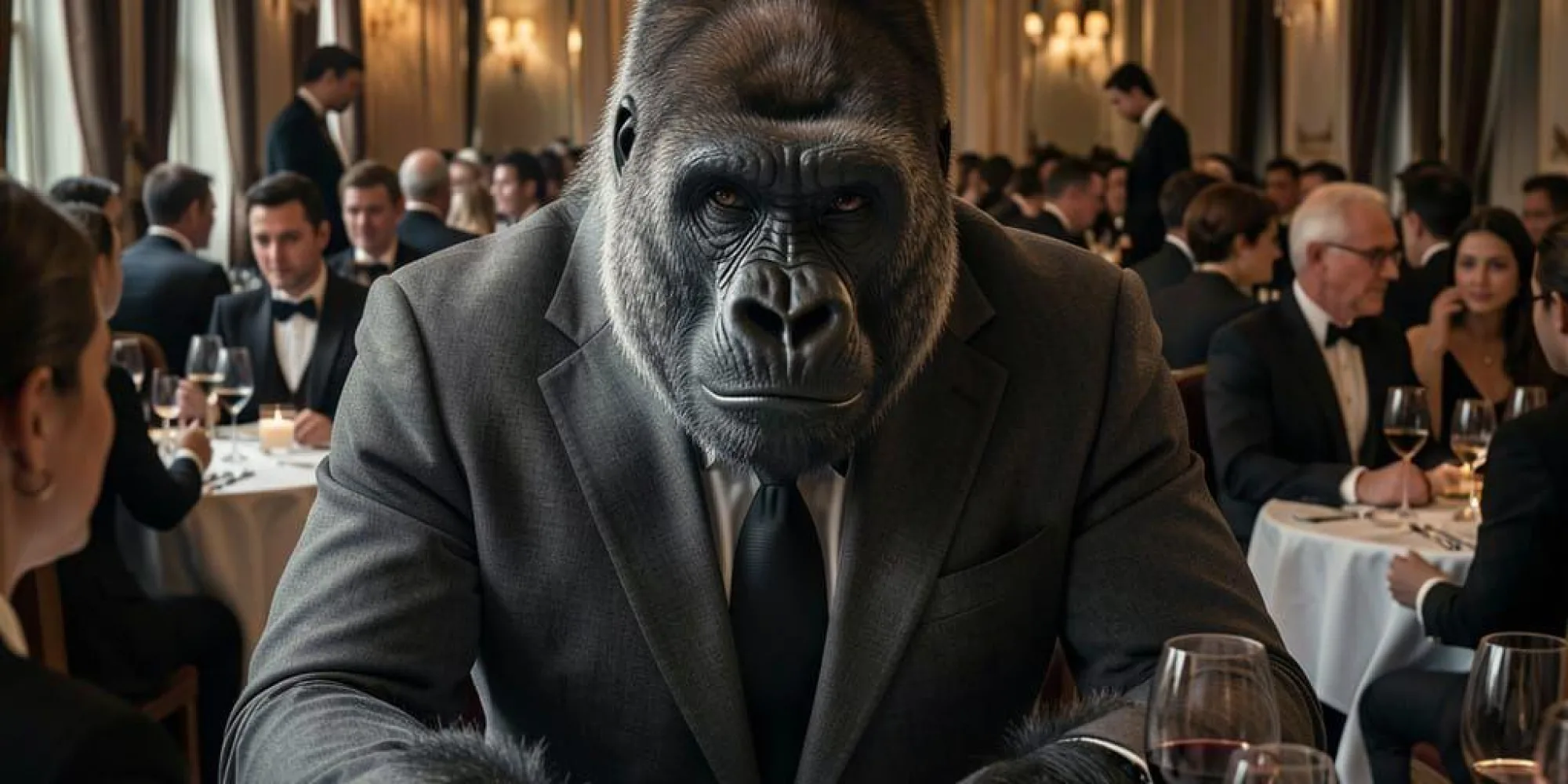
The Gorilla in the Restaurant
There is a famous psychological experiment where participants are asked to watch a short video of two teams passing a basketball and to perform a simple task: count the number of passes made by one team. Halfway through the video, a person in a full gorilla suit walks directly into the middle of the frame, stops, beats their chest, and then walks out again. Roughly half the participants never see the gorilla at all, despite it being right there in front of them the whole time.
What makes the experiment unsettling is not that people miss it, but what happens after. When told about the gorilla, many participants insist it was never there. They do not say they were distracted or that they missed something obvious. They say the video must have been changed, as if the world is wrong rather than their attention. Their confidence increases as their perception collapses, and the mind quietly edits reality to protect the ego’s sense of competence.
The phenomenon is called inattentional blindness, but that term undersells what is really happening. The issue is not eyesight, memory, or intelligence. It is ego and investment. When people are deeply committed to a task, an identity, or a self-image, the brain discards information that threatens that commitment. The gorilla is not ignored. It is erased.
Once you understand that mechanism, you start seeing it everywhere. Entire professional cultures operate inside invisible frames, confident they are seeing the whole picture, blind to anything that does not reinforce their internal hierarchy. They do not merely overvalue themselves. They reorganise reality around that valuation and then defend it as if it were objective truth. In that kind of world, disproving evidence is not processed as data. It is processed as an attack.
I ran straight into that blindness last night in the most ridiculous setting imaginable, which is why it stuck. I watched one point three episodes of Black Rabbit, and that was all I could manage. Not because of the crime plot, which actually had potential, but because the show’s worldview was so delusional I couldn’t stomach it. It felt like it might go somewhere interesting, into greed, gradual decline, and the moment hope dies and people start doing insane things just to survive. I will never know where it was heading, because I tapped out early.
It is one thing when a series satirises the egos of New York chefs. It is another when it takes them seriously, as if we are meant to accept their internal hierarchy of importance as an objective ordering of the universe. In Black Rabbit, that hierarchy appears to run something like this: chefs with Michelin stars at the top, then chefs with glowing New York Times write-ups, then chefs in general, then God, then interior designers who do restaurant fit-outs, and then everyone else. The show treats this ordering as self-evident truth. There is no irony, no distance, and no awareness that the hierarchy itself might be the pathology.
We are expected to accept that a man who can reduce veal stock correctly occupies a higher plane of existence than almost everyone he passes on the street. We are expected to accept that his inner weather matters more than ordinary human life. We are expected to accept that the restaurant world is civilisation and everything else is background. The show is not presenting characters with inflated self-regard. It is presenting a universe that agrees with them. That is the delusion.
The point where I finally tapped out arrived with a hamburger, and it arrived with complete sincerity rather than satire. A fifty-dollar hamburger is delivered on a plate lined with greaseproof paper, served in a grungy pub under the Brooklyn Bridge off-ramp, after a buildup that suggests this burger will transport your soul to the afterlife and then return it safely to your body. The camera lingers, the lighting softens, and the ritual unfolds as if something sacred is taking place. It is presented like a canteen lunch, priced like a pilgrimage, and treated like a holy rite performed by a secular priesthood. The show genuinely believes this matters in a way that transcends proportion.
I can handle darkness, violence, moral collapse, addiction, betrayal, and slow-motion ruin. What I cannot handle is a show that sincerely believes a Michelin-starred chef represents the apex of human civilisation. That belief is not characterisation. It is worldview, and worldview is the one thing I can’t pretend not to see when it announces itself.
This is not a critique of cooking, restaurants, or craft. It is a critique of ego’s ability to hijack perception. The chefs in Black Rabbit are not pretending their world matters more than everyone else’s. They believe it does, and the show backs them up by building a reality in which they are correct. They have missed the gorilla, and like the participants in the experiment, they would insist it was never there.
This is what happens when ego takes over reality. A closed system forms, internal status replaces external relevance, and the hierarchy becomes self-justifying. Anyone outside the frame becomes invisible, and anyone who questions the frame is dismissed as unserious or ignorant. The tragedy is not that chefs care deeply about their work. The tragedy is that the show confuses intensity with importance and competence with transcendence.
That is the New York chef delusion, and it is not unique to chefs. It is simply ego doing what ego always does when it goes unchecked: erasing the gorilla, flattening reality, and insisting that the small world it inhabits is the whole world. Once you see that pattern, you cannot unsee it. And once you see it, you start noticing how often people mistake their position in a system for their position in the universe.

About Jason Bresnehan
Jason writes in a modular, mind‑drift style that moves between business, recovery, faith, anthropology, and the oddities of everyday life without warning or apology. His work blends operator‑grade clarity with sideways narrative turns — the kind that start in a boardroom, drift through Scripture or Tasmanian riverbanks, and land in a piece of doctrine you didn’t see coming.
He has spent years helping organisations and people get unstuck, and his writing reflects the same instinct: take something messy, name it cleanly, and make it usable. His pieces — whether on addiction, Catholic symbolism, business operators, or human quirks — aren’t lectures. They’re field notes. Observations. Fragments designed for real people in real moments, including the tired executive delayed in an airport lounge at 11:45pm.
Jason publishes micro‑chapters as he writes them — standalone pieces that don’t follow a cadence or a theme. They accumulate over time into a larger body of work, shaped by curiosity, faith, operator discipline, and a refusal to perform — just get outcomes.
Founder of the Hadspen Foundation, Jason is committed to building frameworks for spiritual recovery that are both repeatable and personal. His writing is guided by discernment, narrative cadence, and the belief that doctrine should support—not overshadow—the human story.