
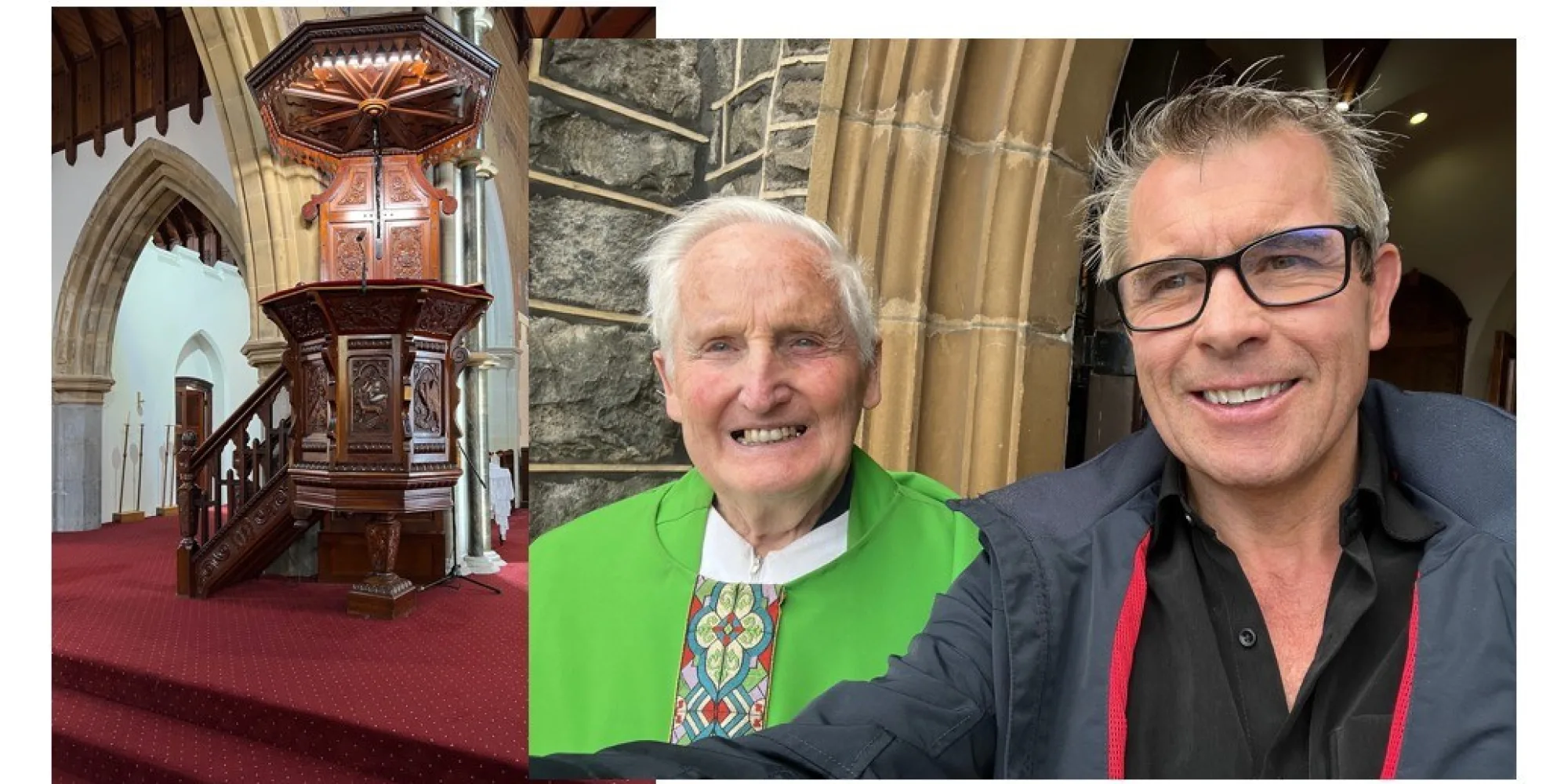
The Gentle Priest, the Tornavoz and the Trailer
The Catholic parishes of Tasmania are in the middle of a “key‑man” reshuffle.
Rev Fr Shammi Perera is moving from Sandy Bay to become Launceston’s Parish Priest, and Fr Leonard Caldera is heading to Westbury. The result: the Church of the Apostles is long on parishioners and short on priests. So today, they pulled Fr Peter O’Loughlin out of retirement from his home in Dodges Ferry to say Mass.
Fr Peter has been retired five years, but he still carries the muscle memory of a man formed in a different Church. In 1969 he spent five years on the ground at the Church of the Apostles — the old pastoral circuits, the pre‑microphone era, the era where a priest’s voice had to fill a cathedral without amplification.
When he climbed the small flight of stairs to the magnificent pulpit, he began with the Gospel — and the “triple sign of the cross.” Most of us go through the motions: thumb to forehead, lips, heart. But Fr Peter wasn’t having it. He stopped us like an AFL coach calling a time‑out and reminded us that the gesture is a prayer:
that the Word of God be in the mind, on the lips, and in the heart.
Then he pointed upward to the ornate timber hexagon canopy suspended above him. I later learned it’s technically called a “sounding board,” designed to project the priest’s voice in the centuries before microphones. But “sounding board” feels pedestrian — a business term, a feedback loop. The French call it an abat‑voix. The Spanish call it a tornavoz. My French is hopeless, but my Spanish is un pocito, so tornavoz it is.
Apparently in the early 70s the tornavoz had developed a serious lean. They worried that if a priest delivered a blood‑and‑fire sermon and thumped the lectern hard enough, it might be the last thing he ever did. So they quarantined it, stored it in an out‑building, and forgot about it — except Fr Peter. Decades later, he was the only one who remembered where it was. They restored it, and now it sits where it should, above the pulpit like a suspended memory.
From there he moved — naturally, if not entirely logically — to football. He wanted us to know that Essendon sits only a few rungs below God in his personal hierarchy. I’ve never heard a sermon from a Collingwood‑supporting priest, but I’ve also never seen a priest with no teeth. Maybe they’re out there.
Today’s Gospel was the first of two annual appearances of the Beatitudes (Matthew 5:1–12a). A spiritual invitation to the poor in spirit, the mourning, the meek, the merciful, the pure in heart, the peacemakers, the persecuted. Fr Peter said he didn’t want to keep us “well past lunch,” so he threaded the Beatitudes like a needle and distilled them to one line:
“It’s all about being gentle.”
Gentle with your wife, your husband, your family.
Gentle with the “checkout chick” at the supermarket — his language, his era, but the same truth.
And this is where his homily aligned perfectly with the third star of your Trinity Stars Doctrine for Recovery:
the Pursuit of Grace through the everyday channels — the micro‑movements of ordinary life.
At the supermarket.
At the service station.
With colleagues.
With strangers.
With God’s children in the small, unremarkable interactions that make up most of our lives.
Different generation.
Same channel of grace.
You could see it land with the faithful. You could feel it.
After Mass, I introduced myself to Fr Peter on the church steps. It turns out he married my mum and dad. And he remembers my father fixing a trailer for him — fifty years ago.
No invoice.
No fanfare.
Just my dad helping a priest with a practical problem.
And here’s the part that matters:
He still remembers the trailer.
Half a century later.
That’s the thing about trailers — they’re never just trailers
They’re borrowed in moments of need.
Fixed without being asked.
Lent without paperwork.
Returned with gratitude.
Remembered long after the reason for borrowing has faded.
Maybe not in Manhattan or London, but in rural Australia, trailers are a high‑value currency of grace. They’re the quiet infrastructure of community — the unspoken agreements, the favours, the “I’ll sort it” moments that build trust over decades.
For Fr Peter, that trailer wasn’t metal and bolts.
It was my father’s character.
A moment of kindness.
A man who rarely went to Mass doing his bit in the way he knew how — fixing things.
A memory that outlived the problem it solved.
Not because the trailer mattered.
Because the grace did.

About Jason Bresnehan
Jason writes in a modular, mind‑drift style that moves between business, recovery, faith, anthropology, and the oddities of everyday life without warning or apology. His work blends operator‑grade clarity with sideways narrative turns — the kind that start in a boardroom, drift through Scripture or Tasmanian riverbanks, and land in a piece of doctrine you didn’t see coming.
He has spent years helping organisations and people get unstuck, and his writing reflects the same instinct: take something messy, name it cleanly, and make it usable. His pieces — whether on addiction, Catholic symbolism, business operators, or human quirks — aren’t lectures. They’re field notes. Observations. Fragments designed for real people in real moments, including the tired executive delayed in an airport lounge at 11:45pm.
Jason publishes micro‑chapters as he writes them — standalone pieces that don’t follow a cadence or a theme. They accumulate over time into a larger body of work, shaped by curiosity, faith, operator discipline, and a refusal to perform — just get outcomes.
Founder of the Hadspen Foundation, Jason is committed to building frameworks for spiritual recovery that are both repeatable and personal. His writing is guided by discernment, narrative cadence, and the belief that doctrine should support—not overshadow—the human story.