
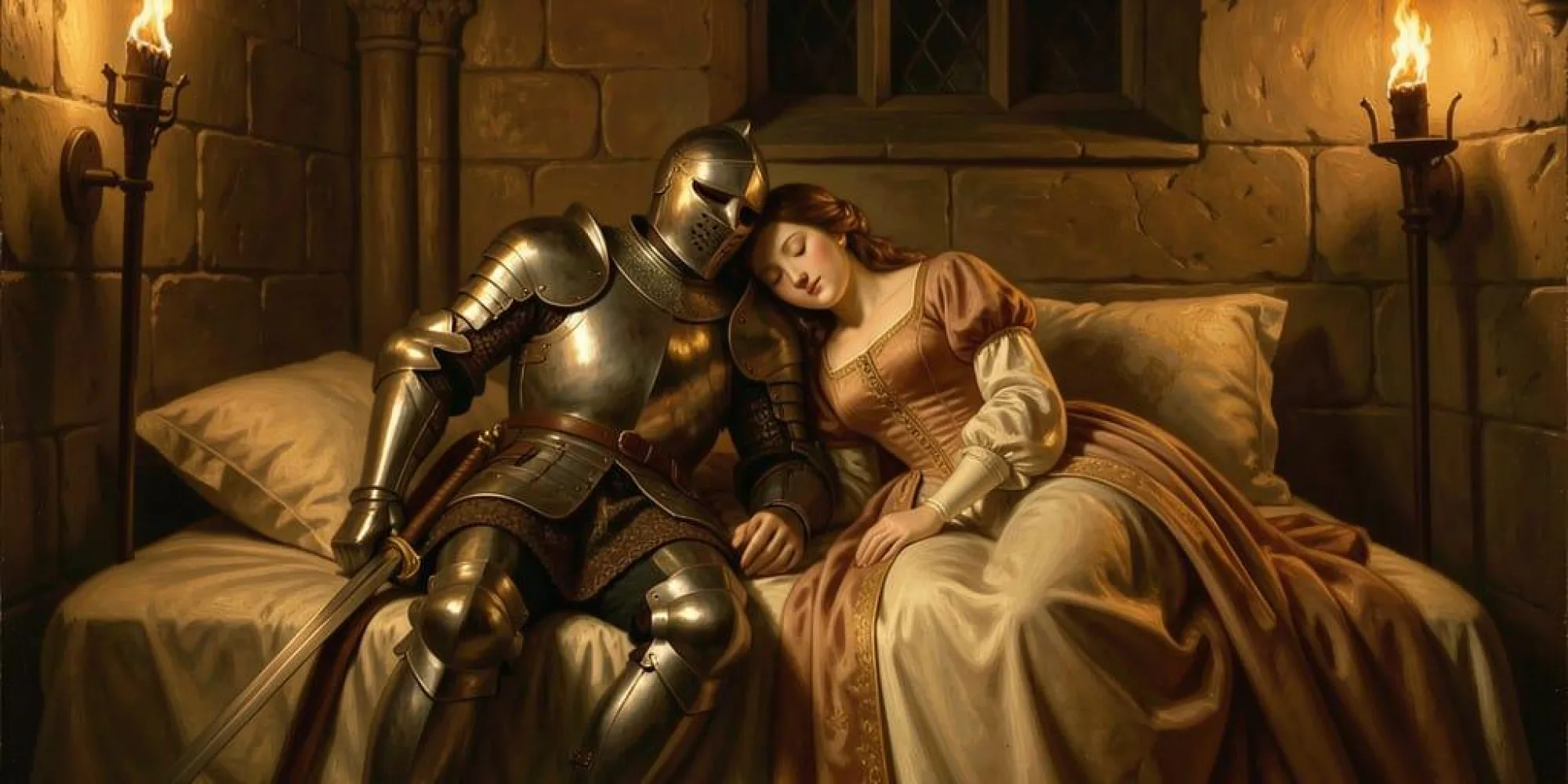
The DNA of Sleeping
Alison came to me the other night and said, “You might think I’m crazy, but I think I have some genetic throwback. I’m on the medieval sleep pattern — first sleep, second sleep.”
I had no idea what she was talking about. Then she explained it, and I was intrigued enough to go digging.
Historians call it segmented sleep or biphasic sleep, and for centuries it was completely normal.
People went to bed not long after sunset — eight or nine o’clock — slept a few hours, then woke naturally around midnight. Not insomnia. Not anxiety. Just the rhythm. They’d spend one to three hours in low light doing quiet things: tending the fire, talking, praying, checking animals, having sex, even visiting neighbours. It was a built‑in meditation window before the word meditation existed. Then they’d go back to bed for the second sleep and wake at dawn.
This pattern shows up everywhere — medical texts, diaries, court records, literature. Chaucer and Dickens both reference “first sleep” and “second sleep.” It wasn’t fringe. It was the default.
Two forces killed it: artificial lighting pushed bedtime later, and industrial schedules demanded a single, continuous block of sleep. So we compressed the whole thing into seven or eight hours and then pathologised anything outside that.
So Alison’s “genetic throwback” isn’t crazy at all. She’s running the medieval firmware.
What fascinates me is how easily people accept physical inheritance. If your great‑great‑great‑great‑great‑great grandfather was recorded as being six foot seven, nobody blinks when you turn out six foot nine. But if the inheritance is invisible — wiring, rhythm, instinct — we dismiss it as imagination. If you can’t see it, it can’t be real.
Except it is real. And it’s a reminder that understanding our ancestors isn’t nostalgia. It’s practical. It changes how we look at ourselves. It stops us treating our quirks as outliers. It lets us embrace the deeper spirituality embedded in both our biological DNA and our soul DNA.
It’s all there. We just have to go looking for it — and then run with it.

About Jason Bresnehan
Jason writes in a modular, mind‑drift style that moves between business, recovery, faith, anthropology, and the oddities of everyday life without warning or apology. His work blends operator‑grade clarity with sideways narrative turns — the kind that start in a boardroom, drift through Scripture or Tasmanian riverbanks, and land in a piece of doctrine you didn’t see coming.
He has spent years helping organisations and people get unstuck, and his writing reflects the same instinct: take something messy, name it cleanly, and make it usable. His pieces — whether on addiction, Catholic symbolism, business operators, or human quirks — aren’t lectures. They’re field notes. Observations. Fragments designed for real people in real moments, including the tired executive delayed in an airport lounge at 11:45pm.
Jason publishes micro‑chapters as he writes them — standalone pieces that don’t follow a cadence or a theme. They accumulate over time into a larger body of work, shaped by curiosity, faith, operator discipline, and a refusal to perform — just get outcomes.
Founder of the Hadspen Foundation, Jason is committed to building frameworks for spiritual recovery that are both repeatable and personal. His writing is guided by discernment, narrative cadence, and the belief that doctrine should support—not overshadow—the human story.