
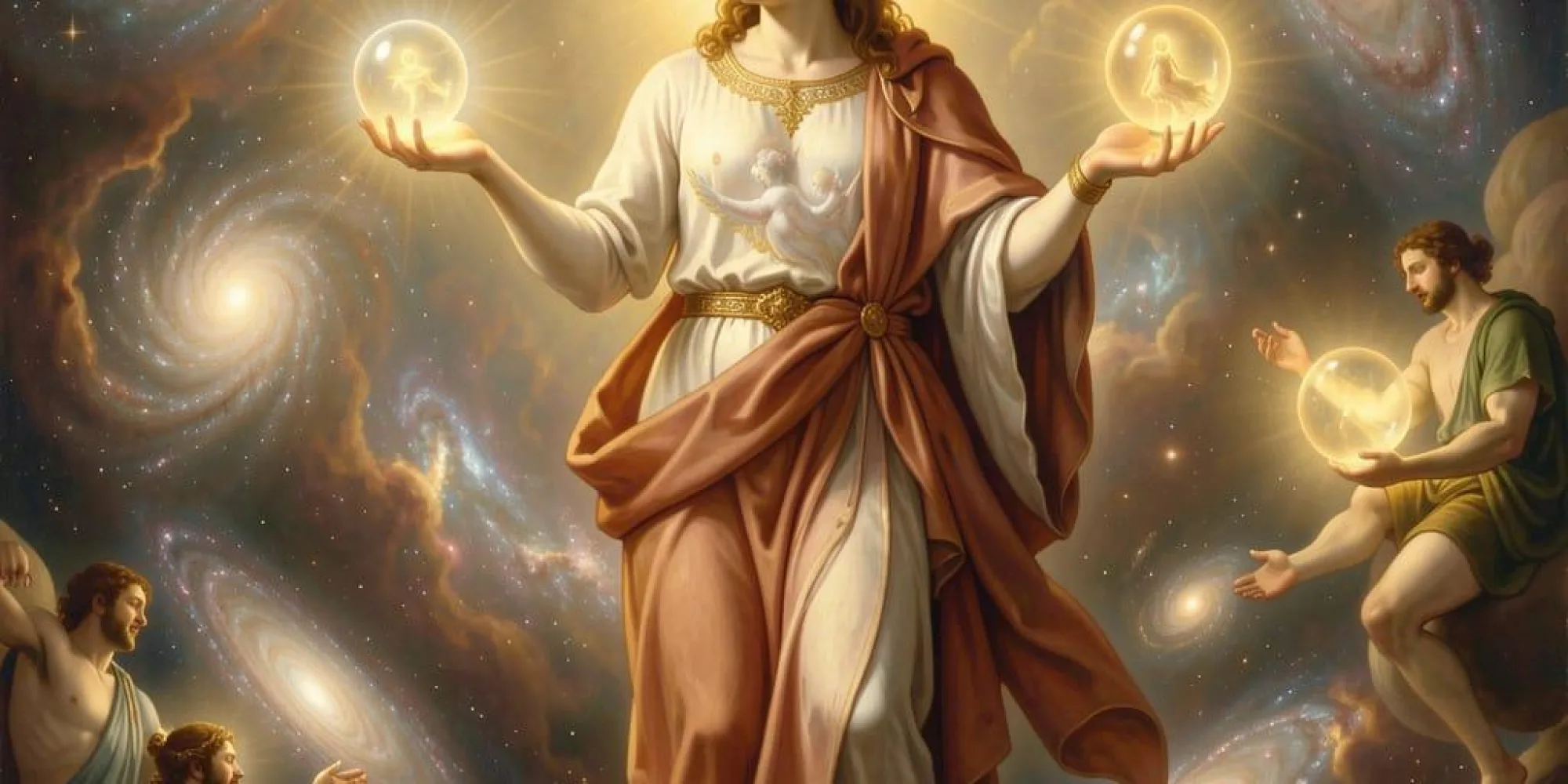
The Distributed Soul
An idea I’ve been circling for years is that a person’s soul — the part that carries their faith, God’s will for them, their spirituality, their emotional architecture, and their personality traits — is inherited in a way that resembles DNA. Not biologically, not genetically, but patterned. Distributed. Passed on through some deeper logic of God’s design.
I never spoke about it. It lived in that private orbit where half‑formed doctrines sit and wait for their moment.
Then something happened that joined the dots in a way I couldn’t ignore. I had sent the first nine draft chapters of my intergenerational memoir, Six Ribbons, to my friend John. He’s a filmmaker whose work has always reached into the deeper strata of the human condition. One of his titles, A Human Search: The Life of Father Bede Griffiths, is a meditation on a Benedictine monk who spent decades exploring the meeting point between Christianity and Eastern spirituality. John isn’t a theologian by title, but he is one by instinct. His creative life is shaped by spiritual curiosity, interiority, and the search for meaning.
After reading those early chapters, he asked me what I was trying to do with them. I told him the truth: they were breadcrumbs — early signals of personality traits and spiritual instincts that I believe I inherited from my great-great-great-great grandmother Mary Butler, who was transported as a convict on the Second Fleet. I said I was trying to show how traits, strengths, wounds, and spiritual sensitivities can echo across generations, even when the people themselves are long gone.
John paused for a moment, and then he asked the question that stopped me cold.
Do you think the soul is inherited like DNA?
He had no idea I’d been circling the same idea for years. But coming from him — someone who has spent a lifetime noticing the hidden architecture of the human spirit — the question landed with the unmistakable weight of grace. It was the moment that said, You’re not the only one thinking about this. Follow it. Flesh it out. There’s something here that wants to be named.
That conversation became the ignition point — the place where a private intuition began to crystallise into a doctrine.
The strange persistence of personality
There is a phenomenon that keeps surfacing in medical literature and in the quiet testimonies of transplant recipients. People who receive organs — hearts, kidneys, livers, even skin grafts — often report changes that cannot be explained by surgery alone. New cravings. New fears. New dreams. New emotional tones. New temperaments. Sometimes even flashes of memory that do not belong to them.
These stories appear across cultures, across ages, across organ types. They form a pattern that refuses to disappear. And patterns, in my experience, are rarely accidents. They are invitations.
The old model — that personality lives only in the brain — cannot account for this. Something else is happening. Something distributed. Something patterned. Something that behaves more like a field than a location.
I began to wonder whether the soul behaves the same way.
If identity can be carried in tissue, why not in lineage?
If emotional tone can be transferred through a heart, why not through generations?
If memory can appear without lived experience, why not without chronological inheritance?
These questions don’t demand answers. They simply open the door.
The body that remembers
When a heart transplant recipient suddenly loves classical music, and the donor was a violinist.
When a child dreams the final moments of the donor’s life.
When a woman develops the donor’s favourite foods and the donor’s phobias.
When a man wakes with a temperament he never had before.
These are not coincidences. They are clues.
They suggest that identity is not confined to the brain. That memory is not a single location. That emotional patterning can be carried in tissue.
The body remembers more than biology.
The scientific cracks in the old model
Science has begun to notice the cracks.
Epigenetic memory — chemical markers on DNA that store emotional history.
Cellular signalling — proteins and receptors that encode past states.
Immune imprinting — donor immune cells carrying behavioural signatures.
Neural-like cells — especially in the heart and gut, capable of storing emotional patterns.
Distributed memory theory — the idea that memory is not a place but a pattern.
None of these mechanisms fully explain organ memory, but together they point to a body where identity is patterned, not centralised.
And if the body is patterned, perhaps the soul is too.
The distributed soul-field
The idea is simple, but it changes everything.
The soul is not a single orb or flame. It is a field distributed through every cell.
Every cell carries a portion of the soul’s pattern — its emotional tone, its spiritual resonance, its inherited traits. The soul is in the body but not of the body. It uses the body as a vessel, but it is not limited by it.
This explains why organ recipients change a little — but not completely. They receive fragments of the donor’s soul-field, but not the donor’s consciousness, spirituality, or moral agency.
The traits are residual. The soul is sovereign.
The invisible inheritance
As I sat with these ideas — organ memory, distributed identity, inherited spiritual tone — something else kept circling back to me. A simple observation I’ve made for years, usually in conversations where people are trying to understand why I take soul inheritance seriously.
What fascinates me is how easily people accept physical inheritance. If your great‑great‑great‑great‑great‑great grandfather was recorded as being six foot seven, nobody blinks when you turn out six foot nine. It makes perfect sense. Height runs in families. Eye colour runs in families. Blood type runs in families. We accept it without question.
But if the inheritance is invisible — wiring, rhythm, instinct, spiritual tone — we dismiss it as imagination. If you can’t see it, it can’t be real.
Every time I say this, I watch the same thing happen. People pause. Their face shifts. They realise they’ve been living inside a contradiction. They’ve accepted the visible without hesitation and rejected the invisible without examination. And they suddenly feel a little embarrassed, because they know — instinctively — that the invisible traits are the ones that shape us the most.
Why do some children arrive with a temperament fully formed?
Why do some people carry wounds they never lived?
Why do some strengths feel older than the person?
Why do some instincts feel inherited rather than learned?
If visible traits can pass through generations, why not invisible ones?
Once you see it, you can’t unsee it.
Death as withdrawal
Near-death experiences add another layer. People describe a pulling sensation, a withdrawal, a feeling of being lifted out of the body. A sudden coherence — as if something scattered is being gathered. A form made of light or colour, often violet or blue. A painful compression when forced back into the body.
If the soul-field is distributed through every cell, then death is the moment the field collapses back into a single coherent form. That would feel like being pulled, lifted, collected. And being sent back — after the field has begun withdrawing — would feel like being forced into a body that no longer fits.
The behaviour of a distributed field and the testimony of the dying seem to rhyme.
Regeneration: how cells recopy the soul
Every seven to ten years, almost every cell in the body has been replaced. Which means the soul-field is continually being recopied into new biological material.
In addiction, those copies are made under stress hormones, inflammation, poor sleep, poor nutrition, emotional chaos, and spiritual disconnection. The copies become noisy, distorted, heavy, anxious, chemically stressed.
In sobriety, the copies are made under calm, clarity, emotional honesty, spiritual alignment, better nutrition, better sleep, lower cortisol, and balanced neurotransmitters. The copies become cleaner, quieter, more coherent, more aligned with the true self.
This is why long-term sobriety produces that unmistakable sensation of finally fitting your own skin. It is not psychological only. It is not spiritual only. It is not physical only. It is all three. The soul-field is being recopied into better biological material.
People in recovery often say, I feel like myself again. I didn’t know how uncomfortable I was until it stopped. I feel like I’ve come home to myself. My skin fits again.
These are not metaphors. They are descriptions of a biological and spiritual re-emergence.
Trauma and emergence
One example that stayed with me was a young woman — Elizabeth, I think her name was — who had been kidnapped and held captive for years. A trauma so severe that most people cannot even imagine surviving it, let alone integrating it. And yet she said something that startled me: she would not go back to the girl she was before. Not because the trauma was good, but because the woman she became afterwards was stronger, deeper, more compassionate, more anchored.
Another example is Matt Long, the New York City firefighter whose memoir The Long Run recounts his near-fatal accident. Struck and dragged under a 20‑ton bus, more than forty surgeries, months in hospital, told he might never walk without a cane. Before the accident he was an elite endurance athlete. After it, he rebuilt himself — slowly, painfully — into someone deeper than the man he had been before. He said he would never go back.
These stories surprised me at first. They felt like outliers. But then I heard the same sentiment in AA rooms. People who say, without hesitation, I would never go back to who I was before. Not because the addiction was good, but because the person they became in recovery was better.
It made me realise something important: the soul-field doesn’t just survive trauma. It reorganises through it. It refines. It deepens. It sheds what was shallow and strengthens what was true. Trauma doesn’t just break people; sometimes it breaks the casing that was hiding the deeper self.
When the body begins to regenerate — when the cells start copying a cleaner, clearer version of the soul-field — the person who emerges is not the same as the one who went in. They are more themselves than they have ever been.
The doctrine of soul inheritance
If the soul is distributed through every cell, and recopied across a lifetime, then perhaps it is also recopied across generations. Traits recur because the soul is re-issued. Inheritance is spiritual, not chronological. Identity is layered, not linear. The body is the vessel, not the source. The soul carries emotional and spiritual architecture across time.
This is the architecture beneath Six Ribbons. The idea that the adult Jason eventually realises the boy Jason was always present — the clarity, the sensitivity, the pattern-recognition, the spiritual instinct. None of it was new. It was buried under corrupted copies. When the vessel is rebuilt, the original pattern re-emerges.
The boy was always there. The soul was always there. The pattern was always there.
It just needed a body that could hold it.
If the soul is a field — distributed, inherited, refined, and capable of reorganising itself through suffering — then perhaps the deepest truth of a human life is this: we are always moving toward coherence. Always moving toward the person God intended. Always being gathered from the scattered places. And maybe the quiet miracle is not that we change, but that we return — again and again — to the self that was waiting beneath it all.

About Jason Bresnehan
Jason writes in a modular, mind‑drift style that moves between business, recovery, faith, anthropology, and the oddities of everyday life without warning or apology. His work blends operator‑grade clarity with sideways narrative turns — the kind that start in a boardroom, drift through Scripture or Tasmanian riverbanks, and land in a piece of doctrine you didn’t see coming.
He has spent years helping organisations and people get unstuck, and his writing reflects the same instinct: take something messy, name it cleanly, and make it usable. His pieces — whether on addiction, Catholic symbolism, business operators, or human quirks — aren’t lectures. They’re field notes. Observations. Fragments designed for real people in real moments, including the tired executive delayed in an airport lounge at 11:45pm.
Jason publishes micro‑chapters as he writes them — standalone pieces that don’t follow a cadence or a theme. They accumulate over time into a larger body of work, shaped by curiosity, faith, operator discipline, and a refusal to perform — just get outcomes.
Founder of the Hadspen Foundation, Jason is committed to building frameworks for spiritual recovery that are both repeatable and personal. His writing is guided by discernment, narrative cadence, and the belief that doctrine should support—not overshadow—the human story.