
The Digger's Lexicon - An ANZAC Day Reflection
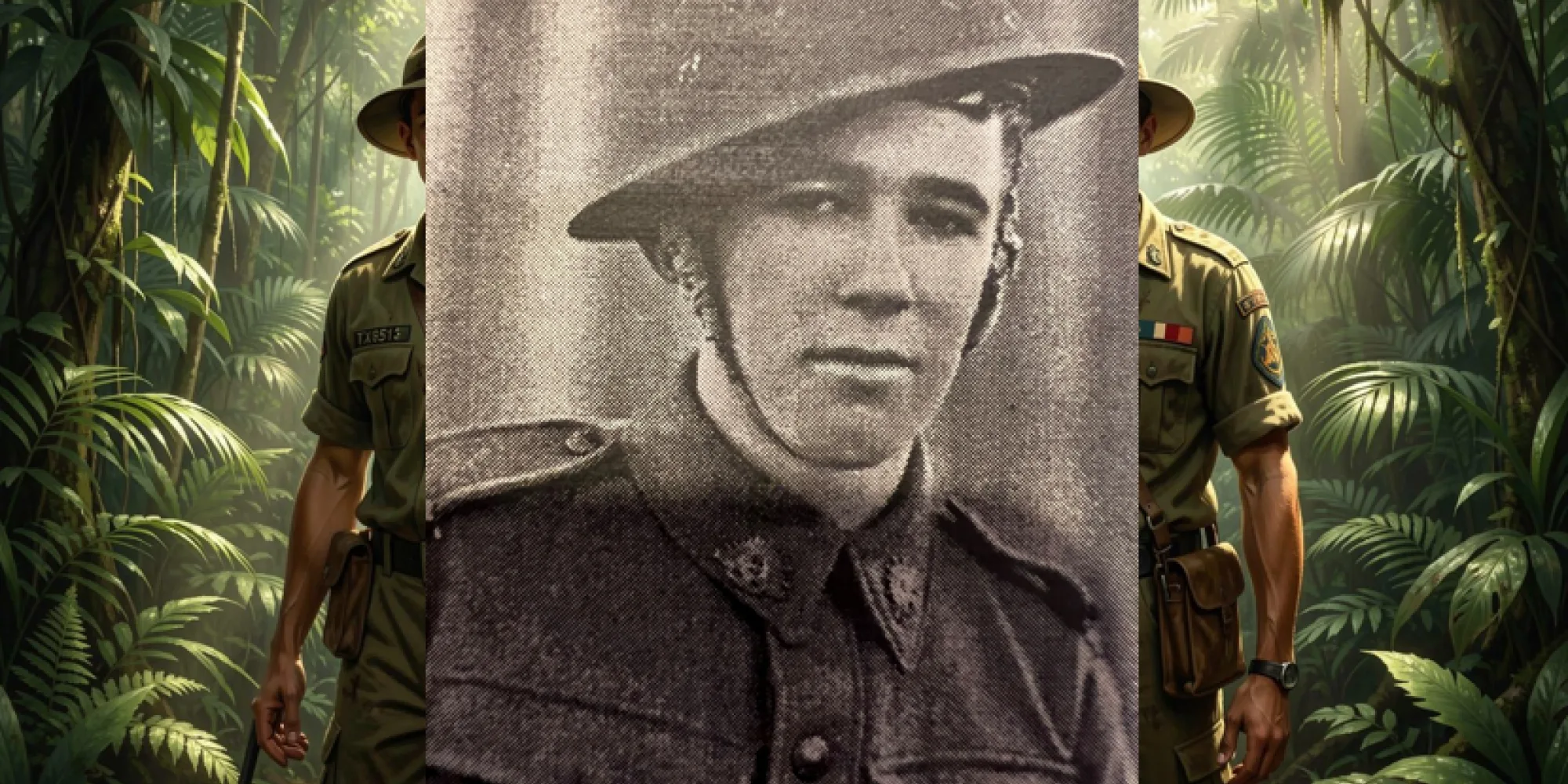
The date was 9 December 1941 my great‑uncle Terence Bresnehan wanted to join the fight in the Second World War. At seventeen years and three months old, he was too young to enlist without parental consent. So his father, Martin, drove him to Hobart to sort out the paperwork.
He was enlisted as a Private, assigned to the 2nd/40th Infantry Battalion, Australian Military Forces, and given the service number TX8513. Known as Sparrow Force, the unit was made up mostly of Tasmanians. On 20 December 1942, that number — with a loved son, a boy, behind it — found itself swallowed by the jungles of New Guinea.
He fought almost from the day he arrived. Thirteen days in, he took a bullet to the forehead. The soldiers fighting beside him buried him quickly in a shallow grave under enemy fire so they could keep moving, but even then they took the time to give this Catholic boy some kind of burial. Through what I can only describe as God’s grace, his fellow soldiers had not moved far when Terence, irritated by the dirt packed into his nose and eyes, wiped his face to clear it. They saw the movement, dragged him from what should have been his grave, and pulled him back into the world.
He was evacuated to the Australian General Hospital in New Guinea, then transferred to the Australian General Hospital in Hobart, and by 7 July 1943 was placed in the Lady Clark Convalescent Home. If his prognosis wasn’t grim enough already, consider 1943 brain surgery — and the fitting of a metal plate into the front of your skull in 1943.
Terence returned to his father Martin Bresnehan’s farm at Risdon Vale, where his dad gave him work. But he was never the same again and sought relief in the bottom of a bottle. My dad recalls staying at Martin’s house as a boy and seeing Terry come home from the nearest RSL club very drunk, raising his voice and announcing to anyone who would listen his grand plans.
Back then an alcoholic was frowned upon as a serial pest — a nuisance who disrupted the family and its social standing, an easy target for gossip. “That Terry is no bloody good.” “He’s not right in the head.” Alcoholics Anonymous may have started in 1939 in Akron, Ohio, but in a world where cross‑country communication was mainly between New York and London, and reserved for political leaders, diplomats and the wealthy, the message of AA did not filter down to Australia until 1945, when the first AA meeting was held at the Rydalmere psychiatric hospital in Sydney. And Sydney is a long way from a farm on the outskirts of Hobart, Tasmania.
Terry had no one to turn to. Alcoholism wasn’t considered a disease or a spiritual malady then. His family essentially ostracised him because he was an embarrassment. He moved to Sydney and somehow lived to seventy‑seven — seventy‑seven years with a metal plate in his head and sixty years of alcoholism that no one understood how to treat. The last two decades of his life consisted of getting to his Manly local at 10 a.m., drinking until 2 p.m., then returning to his tiny flat to drink himself to sleep.
From a national perspective, there were no Australian campaigns more decisive in the Second World War than those fought in New Guinea in 1942 and 1943. Milne Bay and the Kokoda Track were not side‑shows or holding actions. They were fights for the survival of Australia itself. Men like Terence were not sitting around waiting for orders; they were thrown into brutal, decisive combat in terrain that destroyed bodies and minds long after the fighting stopped.
If anyone ever had an excuse to be an alcoholic, Terry had one. But that’s not how recovery works. In recovery it’s helpful — sometimes essential — to understand the root causes of alcoholic drinking, so you can work with others and on yourself to heal what’s underneath, rather than trying to drown it.
I’ve been honoured in my own recovery journey to have come across a number of Australian veterans in the AA rooms I’ve been in. In Australia we give veterans a colloquial name, as we do with many things. “Veterans” is reserved for official government paperwork, but as a term of endearment, respect, and elevation, we call them “diggers.”
It’s a shout‑out to the First World War soldiers who dug trenches on the front lines in France and Turkey. Those battles were not strategic or elegant by any stretch of the imagination. Victory often came down to which side had a constant supply of soldiers willing to climb out of the trenches with a .303 Lee‑Enfield rifle and charge enemy machine‑gun fire until they were senselessly mowed down. It remains one of the most tragic wastes of human life in the last century.
The diggers in recovery I’ve met have experienced the same psychological pain, just in different theatres of war — from the jungles of Vietnam and Malaysia through Desert Storm, Iraq, and Afghanistan. While I can only begin to understand their mental torment, I’ve noticed a pattern in where digger alcoholics struggle to fully leverage the AA recovery tools.
This is by no means a criticism of these diggers, and by no means proven. It is simply what I’ve anecdotally observed, and there is greater than a 50% chance I’ve got it horribly wrong. But I pray that I’m somewhere near the mark, and if I am, I pray that a digger reads this and finds some clarity about the antecedents of their recovery in some small way.
The pattern I’ve noticed is that diggers often misconstrue certain words because of battle‑hardened programming. Words that carry one meaning in war carry a completely different meaning in recovery, yet the old meaning still fires first.
These words aren’t misunderstood because diggers are stubborn or unwilling. They’re misunderstood because war rewires language. It rewires instinct. It rewires the emotional charge behind certain sounds. Recovery asks for softness in places where war demanded hardness. It asks for trust in places where war demanded suspicion. It asks for vulnerability in places where war demanded armour. And that clash of meanings becomes its own invisible battlefield.
“Surrender” is an emotional word even for people who’ve never worn a uniform. It was for me, and I’m no digger. To me it meant giving up — quitting — and for some reason it always conjured memories of the book No Surrender, which I read as a kid because my dad has a deep interest in war history. He owns the oldest Second World War Willys Jeep in the world and a bookcase full of war stories.
No Surrender tells the story of Hiroo Onoda, the Japanese soldier who refused to believe the war had ended and kept fighting in the jungle for almost thirty years. He wasn’t a symbol of fanaticism to me as a kid — he was a symbol of how war turns human beings into something trapped between duty and delusion. It’s a reminder that war is not nations fighting nations; it’s people fighting people, and the brutality of that truth never softens with time.
So when I first came into the AA rooms — having not been a practising Catholic for forty years — and I heard the word “surrender,” the only imagery that came to mind was a white flag being waved on a battlefield. I’ve never been closer to war than what I’ve seen on television, so it’s easy to imagine what a digger sees and hears in his head when that emotionally loaded word is spoken aloud.
In recovery, surrender is a fundamental concept. It means surrendering to God and accepting the things we cannot change. But for diggers, the word lands differently. They don’t hear serenity. They hear white flags. They hear capture. They hear imprisonment. They hear the moment a soldier stops fighting and becomes a POW. Of course they recoil — and recoiling is the exact opposite of what recovery requires.
Recovery asks you to lean in. To trust a higher power. To stop fighting yourself. To stop chasing eight hours of temporary peace at the bottom of a bottle.
Surrender in recovery is not defeat. It is the doorway to serenity.
And for a digger — someone trained to never surrender, someone conditioned to see surrender as the moment a man loses his freedom — that doorway is harder to walk through than most people will ever understand.
Diggers have courage in handfuls. It isn’t just something they possess; it’s a deep part of who they are. In the military it sits alongside two other words — warrior and brave. That trinity isn’t optional. It has to become part of any fighting force, because without it the entire effectiveness dissolves. Courage is not a virtue in war; it is oxygen.
In AA, the Serenity Prayer is said as a group in every meeting, every night, in more than 170 countries. It goes:
God, grant me the serenity to accept the things I cannot change; courage to change the things I can; and wisdom to know the difference.
It’s the second line — courage to change the things I can — that clashes with the meaning a digger hears.
The Serenity Prayer is not asking for the courage to take a bullet, or to live with post‑traumatic stress, or to risk losing your life. In recovery, courage means something far quieter and far harder: the courage to work on your internal state of being. The courage to change the way you think, surrender, and behave.
And this is where the deeper battle begins.
Being a courageous, brave warrior is an identity that does not land well in everyday life. Taking your kids to basketball practice is not a battlefield. It’s not about bravery or warrior spirit. It’s about being present in the small details — like watching your daughter make six excellent attempts at scoring without sinking a single one.
A warrior mindset doesn’t help in that moment. A father does.
It’s about saying, “It’s okay, don’t worry about it. The girls on the other team were very tall. You’ll do better next time. Do you want to stop in for some nuggets on the way home — as long as you promise not to tell Mum.”
That is courage in recovery: the courage to soften, the courage to be human, the courage to live in the ordinary moments without armour.
The final pattern I’ve noticed in the diggers who’ve crossed my path in the AA rooms is the way they relate to the word sacrifice. To be clear, it’s not a word used in the AA lexicon. It’s not a word I’ve heard in any recovery literature. And I doubt psychiatrists or psychologists are talking about sacrifice either.
But some diggers — especially those who believe in Jesus Christ as the Son of God — quietly introduce the concept of sacrifice into their recovery thinking and narrative. And I can see why. The greatest story of sacrifice ever told is the crucifixion of Christ, who died for the forgiveness of our sins. And the willingness to sacrifice their life is absolutely a deep fear that every soldier, pilot, and seaman carries somewhere in the back of their mind.
So when they come into recovery with “sacrifice” hard‑wired into their identity, and they start seeing it as a potential solution to stop drinking, it becomes a very dark place indeed — a place that, if acted upon, is fatal.
Recovery is not asking for sacrifice. It is asking for life.
It is asking for the opposite of what war trained them to do.
Again, my theory — this pattern I think I’ve noticed — is not proven. It’s not being studied as far as I know. It’s just anecdotal observation with no clinical verification at all. But it can’t hurt if AA groups and rehab centres supporting veterans spend an hour explaining that in recovery the words surrender, courage, and sacrifice do not mean what they meant in war.
Not the same. Not even similar.
Because if a digger can understand that these words have a different meaning in recovery — a gentler meaning, a life‑giving meaning — then maybe the path becomes a little clearer. Maybe the load becomes a little lighter. And maybe, just maybe, a man who once fought for his country can learn how to stop fighting himself.

About Jason Bresnehan
Jason writes in a modular, mind‑drift style that moves between business, recovery, faith, anthropology, and the oddities of everyday life without warning or apology. His work blends operator‑grade clarity with sideways narrative turns — the kind that start in a boardroom, drift through Scripture or Tasmanian riverbanks, and land in a piece of doctrine you didn’t see coming.
He has spent years helping organisations and people get unstuck, and his writing reflects the same instinct: take something messy, name it cleanly, and make it usable. His pieces — whether on addiction, Catholic symbolism, business operators, or human quirks — aren’t lectures. They’re field notes. Observations. Fragments designed for real people in real moments, including the tired executive delayed in an airport lounge at 11:45pm.
Jason publishes micro‑chapters as he writes them — standalone pieces that don’t follow a cadence or a theme. They accumulate over time into a larger body of work, shaped by curiosity, faith, operator discipline, and a refusal to perform — just get outcomes.
Founder of the Hadspen Foundation, Jason is committed to building frameworks for spiritual recovery that are both repeatable and personal. His writing is guided by discernment, narrative cadence, and the belief that doctrine should support—not overshadow—the human story.