
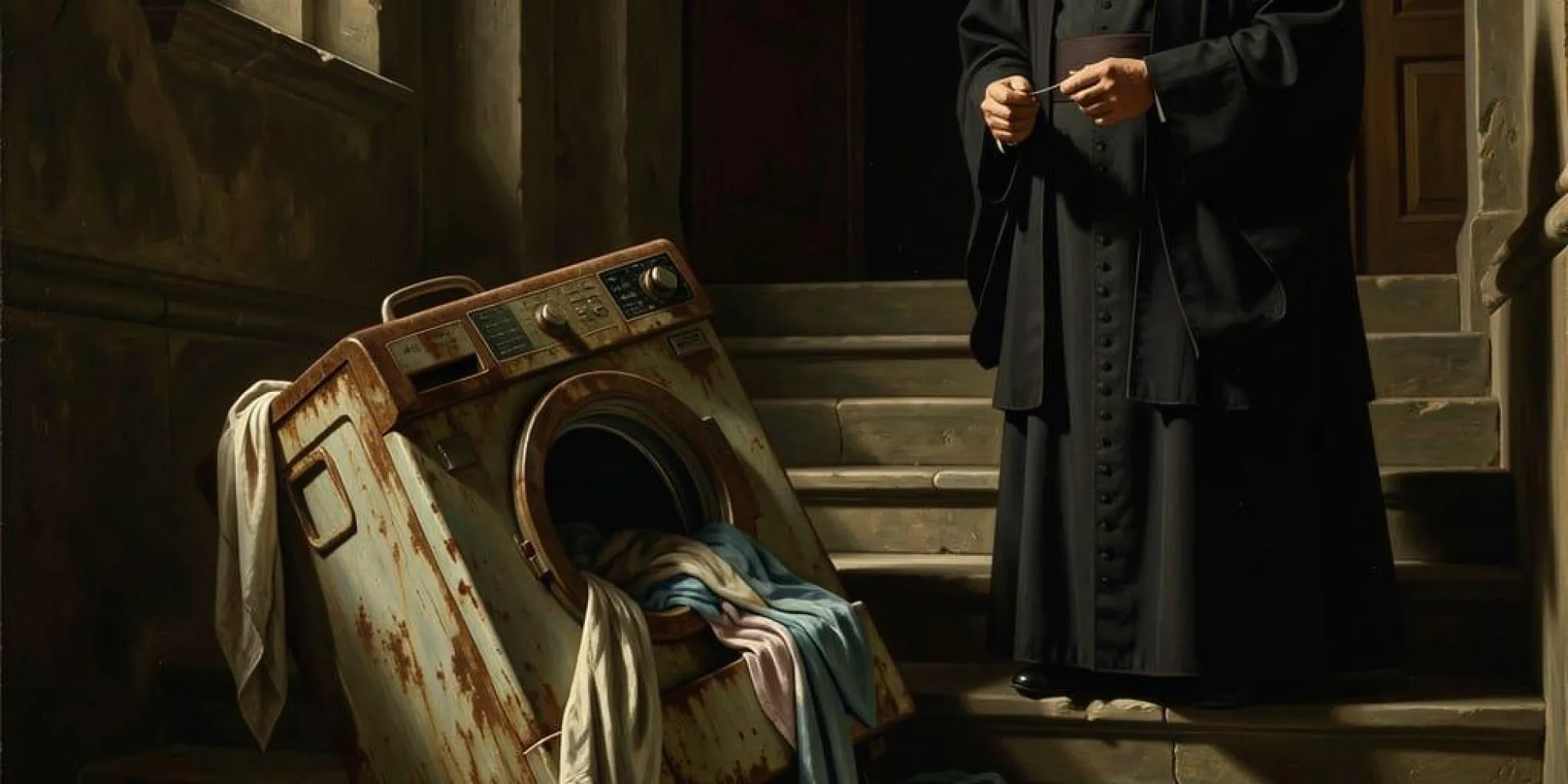
Teach a Catholic Priest to Fish
Last New Year’s Eve, Fr Vinco rang. Once we got through the English barrier, I realised he wasn’t saying the washing machine was dripping — he was saying it was tripping the circuit breaker. Classic presbytery problem: a 15‑year‑old appliance, a public holiday, and a priest with no tools.
I had lunch booked with an old schoolmate to talk recovery and swap stories — including how his brother once ended up playing late‑night Pictionary with Matt Damon in a London castle during a Bourne shoot. But I closed my laptop, climbed into the old LandCruiser with no air‑con and a carburettor begging for retirement, and drove over.
Root‑cause test: plug a kettle into the same outlet.
No trip.
Diagnosis confirmed — the machine was dead.
It was 1 p.m. on New Year’s Eve — the dead zone of Australian trades. No plumber, no handyman, no “mate with a ute” is coming within 50 kilometres of a presbytery laundry on the last day of the year. And even if one did, the script is predictable:
• $200 call‑out fee
• “Not worth fixing, Father”
• “Part will take two weeks”
• “Might as well buy a new one”
I’ve lived that script.
So I bypassed it.
Straight to Harvey Norman.
Picked up a $400 machine — bigger, better, guaranteed to outlive the old one. Negotiated the warranty from three years to five with one line: “This is going to the presbytery.” Instant upgrade.
Ran the numbers:
$394 over 60 months = $6.56 a month.
Who cares.
Just move.
Grace economics.
At the warehouse I asked, “Can I borrow your trolley? I’m installing this at the Catholic presbytery. It’s a God job.” They handed it over like I was transporting the Eucharist. Maybe they thought the dolly would get blessed. Maybe it did.
Back at the presbytery, I installed the machine — but I’d rushed out the door without tools. So I tightened the drainage clamp with a butter knife, the most Catholic tool substitution since loaves and fishes.
It blew off, naturally.
Poor Fr Vinco spent two hours on New Year’s Day not fishing, but mopping the laundry and kitchen. Root cause of the second failure? Butter knives aren’t screwdrivers. And tightening a hose clamp upside‑down in a Chinese factory is very different to tightening one on a cold floor in a presbytery laundry while negotiating with a screw head that wants to live forever.
So the next day I went back with a proper toolbox — not just to fix the clamp, but to leave the priests with the tools they should’ve had all along.
Teach a man to fish.
Teach a priest to tighten a hose clamp.

About Jason Bresnehan
Jason writes in a modular, mind‑drift style that moves between business, recovery, faith, anthropology, and the oddities of everyday life without warning or apology. His work blends operator‑grade clarity with sideways narrative turns — the kind that start in a boardroom, drift through Scripture or Tasmanian riverbanks, and land in a piece of doctrine you didn’t see coming.
He has spent years helping organisations and people get unstuck, and his writing reflects the same instinct: take something messy, name it cleanly, and make it usable. His pieces — whether on addiction, Catholic symbolism, business operators, or human quirks — aren’t lectures. They’re field notes. Observations. Fragments designed for real people in real moments, including the tired executive delayed in an airport lounge at 11:45pm.
Jason publishes micro‑chapters as he writes them — standalone pieces that don’t follow a cadence or a theme. They accumulate over time into a larger body of work, shaped by curiosity, faith, operator discipline, and a refusal to perform — just get outcomes.
Founder of the Hadspen Foundation, Jason is committed to building frameworks for spiritual recovery that are both repeatable and personal. His writing is guided by discernment, narrative cadence, and the belief that doctrine should support—not overshadow—the human story.