
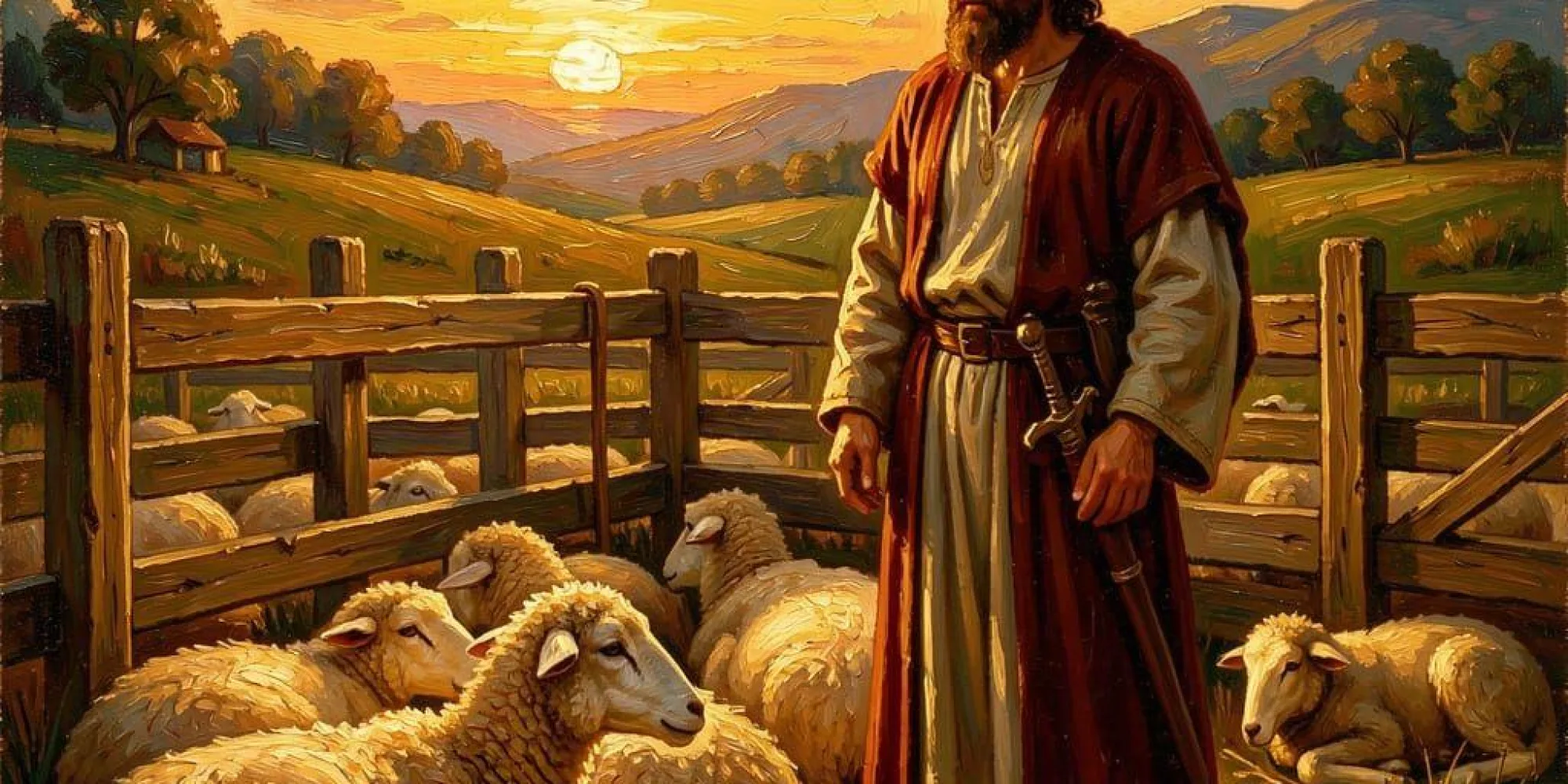
The Gate and the Adversary
Sunday, 26 April 2026: John 10:1–10
Most certainly, I tell you, one who doesn’t enter by the door into the sheep fold, but climbs up some other way, the same is a thief and a robber. But one who enters in by the door is the shepherd of the sheep. The gatekeeper opens the door for him, and the sheep listen to his voice. He calls his own sheep by name, and leads them out. Whenever he brings out his own sheep, he goes before them, and the sheep follow him, for they know his voice. They will by no means follow a stranger, but will flee from him; for they don’t know the voice of strangers.” Jesus spoke this parable to them, but they didn’t understand what he was telling them. Jesus therefore said to them again, “Most certainly, I tell you, I am the sheep’s door. All who came before me are thieves and robbers, but the sheep didn’t listen to them. I am the door. If anyone enters in by me, he will be saved, and will go in and go out, and will find pasture. The thief only comes to steal, kill, and destroy. I came that they may have life, and may have it abundantly.”
Jesus appears to His disciples after the crucifixion. They’re locked in a room. Afraid. Anxious. Disoriented. And He says, “Peace be with you.” That’s not a greeting. That’s a transfer. He replaces their fear with His peace.
Then He breathes the Holy Spirit onto them. That’s empowerment. That’s new life. That’s the ability to live beyond fear.
Fear Is a Root Cause
From my observations—in AA rooms, rehab centers, and among those who haven’t yet begun recovery—fear is often the root cause of alcoholism. But “fear” is misunderstood. Just like “surrender” gets confused with military defeat, fear gets boxed into physical danger—heights, earthquakes, wild animals, violent people.
But the fears that drive people to drink? They’re subtle. They’re buried deep in the onion layers of self. Fear of embarrassment. Fear of not meeting a perceived standard—set by a father, a brother, a mother. Fear of not fitting in. Fear of being judged—for being poor, uneducated, too rich, too pompous, too educated.
My own fear was failure. Fear of not meeting my own expectations. And that’s linked directly to my root cause: hubris. When you talk the talk, you have to walk the walk. And I feared I wouldn’t.
Peace Through Perspective
Recovery reframes fear. It teaches you that surrender isn’t defeat—it’s alignment. You surrender to God. You admit you’re not in control. You accept that God’s plans may not be obvious now—but they’re unfolding. And God is looking after you.
That perspective relieves fear. It doesn’t erase it. But it puts it in context. Jesus breathes peace. He breathes the Spirit. And in recovery, that breath is the beginning of courage.
Locked Rooms and Open Hearts
The disciples are locked in a room. Physically. Emotionally. Spiritually. And Jesus walks through the walls. That’s the Gospel. That’s the doctrine. That’s the miracle. Jesus doesn’t wait for the door to open. He enters anyway.
That’s what grace does. It enters the locked places. The places fear has sealed shut. The places trauma has barricaded. The places shame has padlocked. Jesus walks through those walls. And He says, “Peace be with you.”
Thomas: The Gospel of Doubt
Thomas isn’t there. He hears the story and says, “Unless I see the wounds, I won’t believe.” That’s not defiance. That’s honesty. That’s spiritual transparency. And Jesus doesn’t rebuke him. He returns. He shows the wounds. He meets Thomas where he is.
That’s the Gospel of doubt. Not punished. Not shamed. But met. Jesus meets the doubter. He meets the skeptic. He meets the wounded. And He offers peace—not proof. Presence—not performance.
The Breath of God
Jesus breathes on them. That’s not metaphor. That’s transmission. That’s divine CPR. That’s the breath that created Adam. That’s the breath that parted the Red Sea. That’s the breath that raised Lazarus. And now it’s the breath that empowers the disciples.
In recovery, that breath is the moment you realize you’re not alone. That God is real. That grace is active. That peace is possible. It’s not loud. It’s not dramatic. It’s breath. Quiet. Gentle. Life-giving.
Peace Is the First Gift
Jesus doesn’t give instructions. He doesn’t give doctrine. He gives peace. That’s the first gift. That’s the foundation. That’s the spiritual reset. And it’s offered to the afraid. The anxious. The locked-in.
Peace isn’t the absence of fear. It’s the presence of God. And it’s the first step toward spiritual clarity.

About Jason Bresnehan
Jason writes in a modular, mind‑drift style that moves between business, recovery, faith, anthropology, and the oddities of everyday life without warning or apology. His work blends operator‑grade clarity with sideways narrative turns — the kind that start in a boardroom, drift through Scripture or Tasmanian riverbanks, and land in a piece of doctrine you didn’t see coming.
He has spent years helping organisations and people get unstuck, and his writing reflects the same instinct: take something messy, name it cleanly, and make it usable. His pieces — whether on addiction, Catholic symbolism, business operators, or human quirks — aren’t lectures. They’re field notes. Observations. Fragments designed for real people in real moments, including the tired executive delayed in an airport lounge at 11:45pm.
Jason publishes micro‑chapters as he writes them — standalone pieces that don’t follow a cadence or a theme. They accumulate over time into a larger body of work, shaped by curiosity, faith, operator discipline, and a refusal to perform — just get outcomes.
Founder of the Hadspen Foundation, Jason is committed to building frameworks for spiritual recovery that are both repeatable and personal. His writing is guided by discernment, narrative cadence, and the belief that doctrine should support—not overshadow—the human story.