
Pressure Plates and Trip Wires
I found The Wire the old way, before the internet turned curiosity into a menu. A Blockbuster aisle, a plastic case, and a city on the cover I couldn’t place without an atlas. I knew nothing about it. No reviews. No trailers. No algorithm whispering in my ear. Just a blue box with a skyline I didn’t recognise. It was a punt, the kind you took when discovery still required risk.
By then the video store had already lived through its own evolution. First came the VHS era, a world of plastic bricks and magnetic tape, where rewinding was a civic duty and the entire system ran on friction. Then the DVD arrived, shrinking the physical footprint of entertainment and eliminating the labour of rewinding. And finally the box‑set era emerged — the moment when people with a little mortgage headroom could buy entire seasons outright and take them home like a private archive. That’s where I was standing when I picked up The Wire.
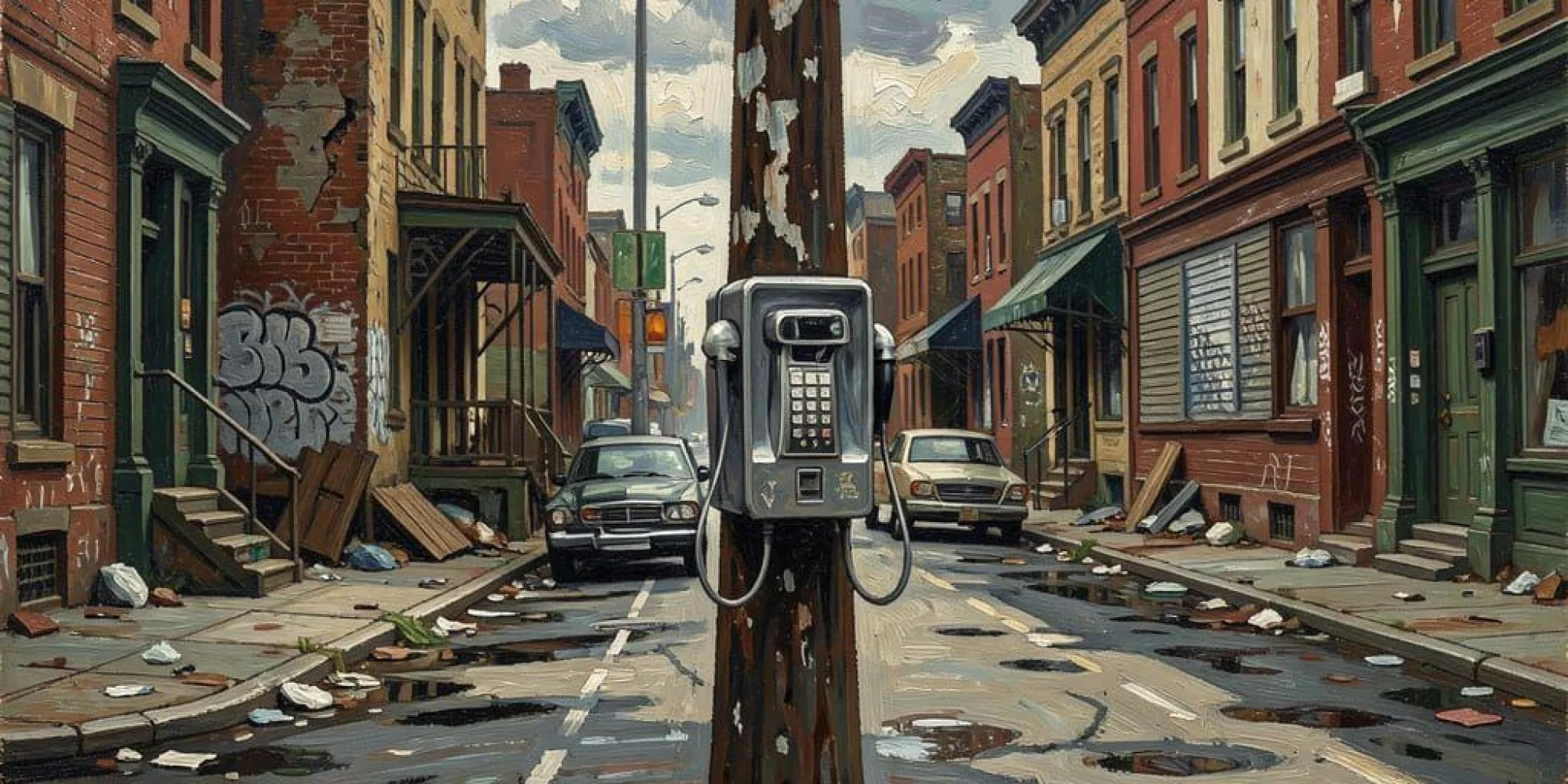
I took it home, pressed play, and within minutes I was confused. The show was full of pagers and payphones. Drug dealers lining up at phone booths. Police using clipboards and landlines. It looked like late‑1980s technology, the kind of world I associated with American hospital dramas where only surgeons carried pagers. In Australia, pagers never took hold. We skipped them entirely. Doctors had them. Nobody else did. I never owned one.
And that’s what made the show feel like a period piece — except it wasn’t. The car models, the background details, the clothing, the references — all of it pointed to the early 2000s. The same year the show was filmed. The same year it aired. The same year I was watching it.
By 2002, my own life had already moved far beyond the world on the screen. I had been fired from KPMG a decade earlier, partly because I was running an import–export business out of my top drawer. In that drawer sat a brick‑sized Nokia, the first mobile phone in the Launceston office of seventy people. By 1994, when I travelled to the United States for the first time, I’d upgraded to a Motorola flip phone. A month of international roaming on that device cost the kind of money that could have been a car payment on an AMG Mercedes. By 2002, I had been to the US around twenty times. I carried prepaid burner phones to avoid the roaming charges on my Australian mobile. I was using a Windows‑powered HTC with a fold‑out keyboard and stylus, syncing contacts and calendars long before the iPhone existed.
Australia had been a mobile‑first country for years. Adults had phones. Teenagers had phones. The butcher, the baker, the candlestick maker — all of them had phones. Mobile communication wasn’t a novelty. It was the air we breathed.
So when I watched The Wire depict a 2002 Baltimore running on pagers and payphones, it felt like stepping into a parallel timeline. The most technologically advanced country in the world was operating on communication tools that looked a decade behind the world I lived in. A world where criminals used pagers and police used clipboards. A world where the entire drug economy depended on phone booths. A world where the police department’s greatest investigative weapon was a wiretap on a landline.
The absurdity wasn’t exaggerated. It was simply true. The technology wasn’t a stylistic choice. It was a symptom. A sign of a city that had fallen out of sync with the world around it. A city operating on legacy systems while the rest of the world moved on. A city where the past hadn’t ended and the future hadn’t arrived.
Once the shock of the technology settled, the deeper structure of the show began to reveal itself. The pagers and payphones weren’t nostalgia. They were symptoms of a city that had fallen behind in more than one dimension. The technology was just the first clue. The institutions were the second. The show wasn’t built on heroes or villains. It was built on systems, and the pressure those systems exerted on the people trapped inside them.
Most crime dramas need a villain. Not because the world works that way, but because the narrative architecture does. A villain gives the story a face. A villain gives the audience a target. A villain keeps the moral universe tidy. The Wire refused that framework. It didn’t give me a villain. It gave me a system.
In The Wire, the antagonist is the system — the police department, the drug economy, the schools, city hall, the whole machinery of Baltimore. Systems stay alive because they create incentives: money, power, and social acceptance. Those incentives keep people inside the machinery, doing whatever they have to do to survive. Nobody stays because it’s noble. They stay because the system makes leaving harder than enduring.
The police department wasn’t corrupt in the cinematic sense. It was corrupt in the bureaucratic sense, the kind that grows out of metrics, quotas, and political optics. The drug trade wasn’t evil. It was an economic adaptation. The schools weren’t failing because teachers didn’t care. They were failing because the system was designed to measure compliance, not learning. The media wasn’t lying. It was starving.
Every institution in the show was doing exactly what it was built to do. And that was the horror. Not malice. Design.
The structure of the show made more sense once I saw it that way. It wasn’t a drama. It was an autopsy. Season One was the police department, the nervous system. Season Two was the docks, the musculoskeletal system. Season Three was politics, the circulatory system. Season Four was the schools, the reproductive system. Season Five was the media, the immune system. Each season opened a different cavity, exposed a different organ, and showed how the same pressure moved through different tissue.
By the end, the entire body was visible. A city collapsing not because of villains, but because of systems.
Baltimore entered my life as a name without weight. It wasn’t a place I had travelled to, and it wasn’t a place that ever came up in conversation. Even when I flew into Washington on a storm‑tossed night, stepping off a small jet that felt like it had been shaken apart in the sky, the geography around the capital didn’t register as anything more than a blur of lights and highways. Baltimore was close enough to touch, yet it never appeared on my internal map. A city hiding beside the most powerful capital on earth, and somehow invisible.
That invisibility wasn’t just geographical. It was cultural. I watch a lot of American news — more than Australian — because when America sneezes, Australia catches a cold. Trends, politics, culture, economics, all of it flows downstream. And yet in all those years of watching American news, Baltimore barely appeared. A city an hour from the centre of global power, and it might as well have been sealed behind a curtain. It only re‑entered the national conversation when the Francis Scott Key Bridge collapsed after being struck by a foreign‑flagged container ship. A major span, one of the city’s defining structures, taken out in seconds. The ship wasn’t carrying American manufacturing to the world. It was moving global cargo through an American port — a reminder that the old industrial engine had been replaced by a global one.
That forgetting was its own kind of pressure. A city overshadowed by a neighbour so dominant it distorted the geography around it. Washington projected power across the world. Baltimore absorbed the consequences. One city shaped global policy. The other lived in the slipstream of decisions made a few exits down the interstate. Geography isn’t neutral. Geography is pressure. Geography is destiny.
The land came first. Before the institutions, before the politics, before the economics, there is the physical shape of the place. Baltimore sits on the edge of the Chesapeake Bay, a port built for an industrial engine strong enough to anchor entire neighbourhoods. When that engine failed, the geography didn’t shift with it. The docks stayed. The warehouses stayed. The empty industrial corridors stayed. The infrastructure of prosperity remained long after the prosperity left. A city built for an economy that no longer existed.
The neighbourhood layout added another layer of pressure. Baltimore isn’t a grid. It’s a patchwork. One block stable enough for kids to play. The next block riddled with drug dealers — the kind of corner no parent wanted their vulnerable, impressionable children anywhere near. Geography funnels people into patterns long before any institution gets involved. Corners, alleys, cut‑throughs — each one a small gravitational field shaping behaviour.
That was the geography I had never learned. A city overshadowed by its neighbour, defined by the land beneath it, shaped by an industrial past that refused to leave. The geography explained the pressure. It explained the trajectories. It explained why the characters moved the way they did. The land came first. Everything else was a response.
Baltimore’s second pressure plate — the one the characters in The Wire were forced to respond to whether they understood it or not — was the port. The city’s industrial engine had once been strong enough to power entire neighbourhoods. Steel, shipping, manufacturing, longshore work — the kind of mid‑skill labour that built houses, sent kids to school, and kept families stable for generations. The port wasn’t just infrastructure. It was identity.
Then globalisation arrived, and the ground shifted. Containerisation changed the economics of shipping. Labour arbitrage changed the economics of manufacturing. The work that had once anchored the city moved offshore, following cheaper wages and lighter regulation. The port stayed where it was, but the purpose behind it evaporated. The ships still came, but they weren’t carrying American goods to the world. They were moving global cargo through an American port. Baltimore had gone from exporter to throughput point. From engine to node.
The collapse wasn’t dramatic. It was geological. Slow, grinding, inevitable. A tectonic plate moving beneath the city until the surface buckled. The industrial corridors emptied out. The warehouses went dark. The jobs that had once held neighbourhoods together disappeared, leaving a vacuum that reshaped the entire city. The old industrial spine had been removed, and nothing of equal weight replaced it.
That was the pressure the characters in The Wire were forced to navigate. Not a moral failure. Not a cultural flaw. A structural shift. A global economic realignment that hit Baltimore harder than most because the city’s identity had been tied to the kind of work globalisation erased.
The port explained the instability. It explained the desperation. It explained why the city’s surface looked calm in some places and fractured in others. When the industrial plate moved, everything above it moved too.
Then there were the institutions — Baltimore’s third pressure plate. The systems that set many of the limits on anyone who wasn’t high enough inside them to shape the outcomes.
Institutions in Baltimore didn’t operate as neutral referees. They were machines with their own momentum, their own incentives, their own blind spots. Police, schools, courts, unions, city hall — each one had a logic that didn’t bend easily, and certainly not for the people working at the bottom of them. And this was the world men like McNulty, Stringer, D’Angelo, Bunny, Bubbles, and the boys from Season Four were forced to navigate. They weren’t abstractions. They were people trying to move through systems that had been calibrated long before they arrived.
McNulty was a homicide detective with the instincts of a truth‑seeker trapped inside a department that rewarded numbers instead of honesty. The institution didn’t care about his clarity. It cared about its metrics. Clearance rates, arrest stats, quarterly targets — the machinery rewarded the appearance of control, not the reality of it.
Stringer Bell lived in a different institution entirely — the informal, brutal, and deeply structured world of the drug economy. He tried to run a criminal enterprise like a corporation, caught between the logic of capitalism and the physics of the street. He wasn’t fighting individuals. He was fighting the institutional gravity of a world that punished ambition and rewarded predictability.
D’Angelo Barksdale was pulled into a rough, low‑rent drug crew that carried his surname but offered him nothing in return. Avon — his uncle and a volatile, street‑level shot‑caller with just enough structure to keep the crew running and just enough dysfunction to keep D’Angelo in his place. D’Angelo could give orders on a corner, but he couldn’t shape the direction of anything that mattered. He saw the system clearly enough to know it was crushing him, but he had no way out. His institution wasn’t legacy or inheritance. It was obligation — enforced by family pressure, street expectation, and the simple fact that he was born with the wrong last name in the wrong environment.
Bunny Colvin was a police major — a career administrator who understood the city better than the people running it. He tried to reform an institution that had no interest in reforming itself. Competence wasn’t the currency. Compliance was. And the institution crushed him for refusing to play along.
Bubbles was a street‑level hustler and informant, a man who survived by reading the city with more accuracy than most of the people paid to police it. His institution was the street — a place where survival required intelligence, instinct, and guilt in equal measure. He wasn’t failing to rise above his circumstances. He was navigating a system that had been designed without him in mind.
And the boys from Season Four — Namond, Michael, Randy, Dukie — were shaped by institutions long before they understood what an institution was. Family, violence, bureaucracy, neglect. Four boys, four trajectories, each one determined by a different form of pressure. The school system didn’t see them. The political system didn’t serve them. The institutional plate had already shifted beneath their feet.
Every institution in Baltimore had its own weather system — storms that rolled through without warning and reshaped the ground beneath anyone caught inside them. McNulty, Stringer, D’Angelo, Bunny, Bubbles, the boys from Season Four — none of them were steering anything. They were trying to keep their footing while the machinery around them lurched and buckled, throwing up arrests, overdoses, bullets, betrayals, and informants as naturally as rain. The pressure wasn’t theoretical. It was the daily cost of staying alive inside systems that never stopped moving.
Culture in Baltimore wasn’t a slogan or a festival or a set of values printed on a brochure. It was the operating system people ran on — the reflexes, codes, jokes, silences, and survival habits that shaped how they moved through the city long before they had language for any of it. Geography set the stage. Institutions set the limits. Culture decided how people behaved inside those limits.
Baltimore culture wasn’t one thing. It was a mosaic of neighbourhoods, corners, crews, parishes, precincts, classrooms, and rowhouses — each with its own rules, its own humour, its own way of reading danger and opportunity. You could cross three blocks and feel like you’d crossed three countries. And everyone in the city knew how to read those shifts without thinking. It wasn’t taught. It was absorbed.
On the west side, the culture of the corners ran on reputation, proximity, and the physics of respect. A look, a pause, a wrong word at the wrong moment — these weren’t small things. They were signals. And signals mattered more than speeches. You didn’t survive by being the toughest. You survived by reading the room faster than the next man.
In the police department, the culture was its own ecosystem — part Irish wake, part locker‑room comedy, part bureaucratic trench warfare. The jokes were armour. The cynicism was a survival tool. The rituals — the bar, the shift change, the paperwork dance — were the glue that held the place together even as the institution itself kept failing. And then there were the private rituals, the ones no supervisor ever saw. McNulty and Bunk had theirs under the O’Donnell Street Bridge in Canton, the same spot where McNulty once drunkenly crashed his car into a support pillar and backed up to hit it again. They’d take a bottle of bourbon down to the rocky shoreline, talk through the corners they’d cut, the rules they’d bent, the lies they’d need to keep straight, and the resentments they had to bleed off before the next shift. It was the police version of a boutique consulting firm’s Friday debrief — except instead of beanbags, Pinot Noir, and a whiteboard full of action items, it was two detectives drinking too much under a bridge and marking the end of the week by smashing empty bottles against the stones. Fans later joked about the “Jimmy McNulty Memorial Bridge Pillar,” but the ritual wasn’t a joke. It was how two men survived a job that demanded more than it ever gave back.
In the drug economy, culture wasn’t swagger or mythology. It was a rulebook written by pressure. The Barksdale crew, Proposition Joe’s co‑op, and later the Stanfield organization didn’t survive because they were reckless. They survived because they were clever in ways the city forced them to be. They treated the corners like a supply chain, the stash like inventory, and the police like a hostile competitor with better funding. Their intelligence wasn’t academic. It was adaptive. They built counter‑surveillance into their daily habits — pagers instead of phones, coded numbers instead of conversations, payphones instead of traceable lines. Stringer enforced a no‑phone policy long before corporations discovered “operational security.” Runners separated cash from product so no one ever got caught with both. And every corner boy knew the first rule of the street: the police only had to be lucky once.
In the schools, the culture was shaped by exhaustion, improvisation, and the quiet heroism of teachers who knew the system wasn’t built for the kids in front of them. The pressure didn’t come from lesson plans or curriculum. It came from a bureaucracy obsessed with test scores — a numbers game that forced teachers to “teach to the test” the same way the police massaged crime stats. The classroom wasn’t a sanctuary. It was a frontline. A handful of traumatised or disengaged kids could derail an entire lesson, and everyone in the room knew it wasn’t their fault. Poverty, violence, hunger, and the corners walked into the classroom every morning before the bell rang.
Prez Pryzbylewski — a former police officer who stumbled into teaching after washing out of the department — learned this the hard way. He arrived with optimism and left with the understanding that caring wasn’t enough. He could connect with the kids, build trust, even spark moments of clarity — but he couldn’t outrun the gravity of their home lives or the bureaucracy above him. The job wasn’t impossible because the kids were difficult. It was impossible because the system demanded miracles from people who were already stretched thin. Teachers weren’t burning out because they lacked passion. They were burning out because they were trying to hold back a tide that never stopped rising.
Culture wasn’t decoration. It was the daily physics of how people survived the geography and institutions pressing down on them. It shaped who spoke up, who stayed quiet, who ran, who froze, who schemed, who adapted, who broke, and who kept going. It was the invisible plate under every decision, every mistake, every betrayal, every moment of grace.
The characters in The Wire weren’t heroes or villains. They were pressure responses — human shapes bent by geography, institutions, and culture, and by the incentives those pressures created. None of them were free agents. None of them were writing their own story. They were adapting to the machinery around them, each in their own way, each with their own cost.
McNulty was a pressure response to institutional incentives — a man who pushed against the department because the department rewarded the appearance of control instead of the reality of it. Bunk was a pressure response to cultural norms — a detective who survived by moving with the current instead of against it. Daniels was a pressure response to political optics — a man who understood that every decision inside the department was a negotiation between principle and survival. Stringer was a pressure response to economic constraints — a businessman trapped inside a street economy that punished ambition. Avon was a pressure response to geography and reputation — a man shaped by the corners, the towers, and the invisible borders that defined power in West Baltimore.
They weren’t moral opposites. They were different adaptations to the same pressure plates. The system didn’t just shape their choices. It shaped the limits of what choices were even available. And that’s the point: once you see how these pressures operate, you can finally see the larger structure they sit inside.
The system’s pressure plates are permanent — the geography, the institutions, the culture. And the plates aren’t moving for any of us. But once you see how they work you stop moving like someone being shoved around by forces you can’t name. Pressure stops feeling like fate when you understand its source. And once you understand the machinery, you stop mistaking its weight for destiny. The system will outlast you. It will outlast all of us. But that doesn’t mean you live like someone waiting to be crushed. It means you move with precision instead of panic, strategy instead of superstition, clarity instead of excuses. You don’t get to choose the plates. None of us do. But you do get to choose how you move across them. And once you see the field clearly, the system stops being a threat and becomes terrain to conquer.

About Jason Bresnehan
Jason writes in a modular, mind‑drift style that moves between business, recovery, faith, anthropology, and the oddities of everyday life without warning or apology. His work blends operator‑grade clarity with sideways narrative turns — the kind that start in a boardroom, drift through Scripture or Tasmanian riverbanks, and land in a piece of doctrine you didn’t see coming.
He has spent years helping organisations and people get unstuck, and his writing reflects the same instinct: take something messy, name it cleanly, and make it usable. His pieces — whether on addiction, Catholic symbolism, business operators, or human quirks — aren’t lectures. They’re field notes. Observations. Fragments designed for real people in real moments, including the tired executive delayed in an airport lounge at 11:45pm.
Jason publishes micro‑chapters as he writes them — standalone pieces that don’t follow a cadence or a theme. They accumulate over time into a larger body of work, shaped by curiosity, faith, operator discipline, and a refusal to perform — just get outcomes.
Founder of the Hadspen Foundation, Jason is committed to building frameworks for spiritual recovery that are both repeatable and personal. His writing is guided by discernment, narrative cadence, and the belief that doctrine should support—not overshadow—the human story.