
Hang Around the Topic
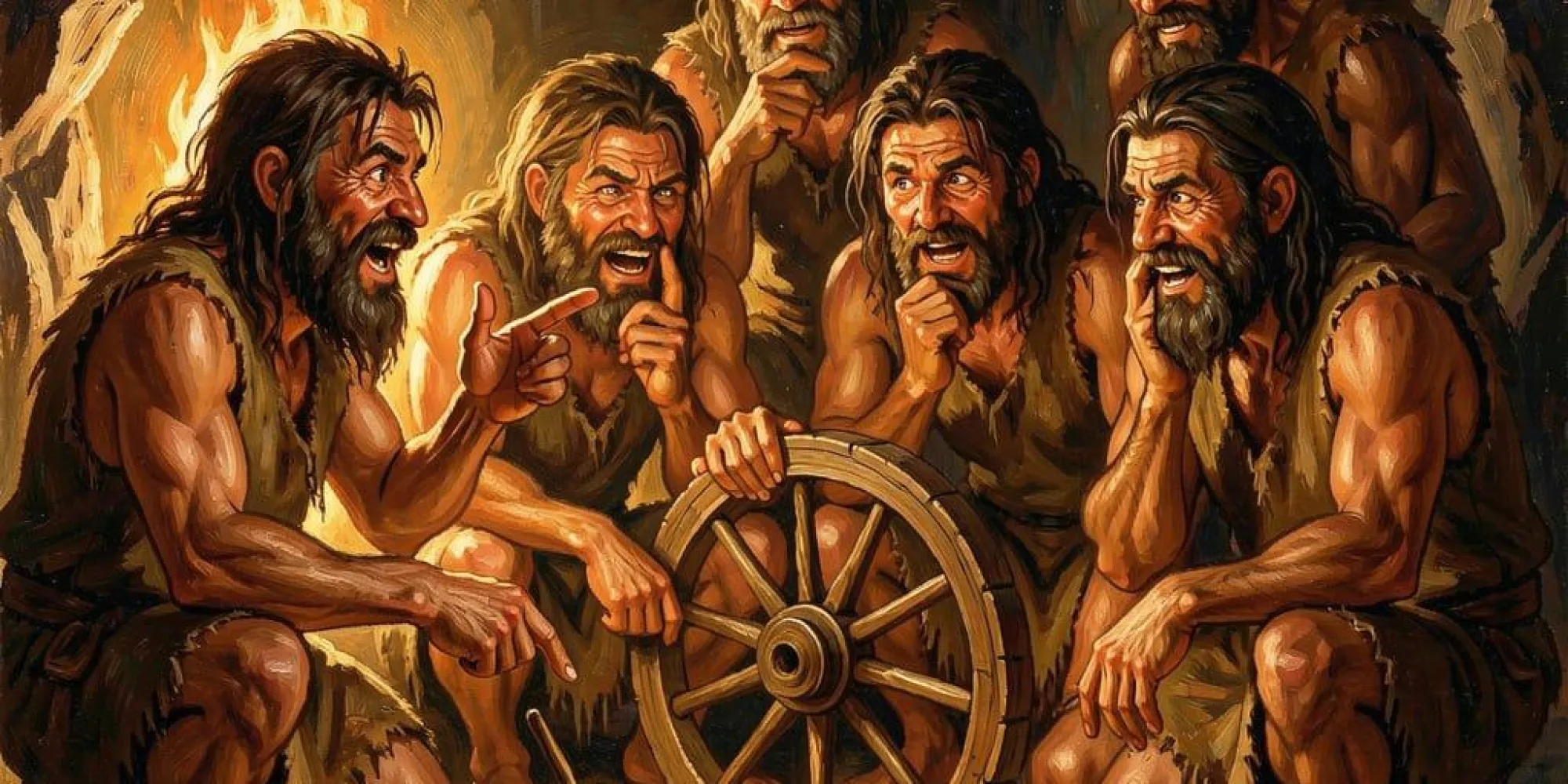
Civilisation does not organise itself through plans. It organises itself through people staying close to something long enough for things to start happening around them. There is no central design and no coordinated entry point. People gather around a subject because it holds their attention, and for reasons that are rarely explained, they stay. Others arrive, sometimes deliberately, sometimes by accident. Over time, those people begin to run into each other, and those collisions begin to move the work forward in ways that were never planned.
Florence did not begin as a theory of greatness. It became Florence because painters, sculptors, engineers and patrons remained close to the same work long enough for it to take on a life of its own. Stone, pigment, proportion and structure filled the same streets. Michelangelo stayed with a block of marble that others had already given up on and produced something that could not have been predicted at the outset. Leonardo moved across anatomy and machines because he stayed near the questions long enough for the boundaries between them to blur. Brunelleschi did not solve the dome in a moment of inspiration; he stayed inside the problem until it began to respond.
They were not part of a system and they were not solving a coordinated brief. They were simply nearby, working within sight of each other, absorbing and reacting without needing to formalise what they were doing. Ideas moved because people saw them. Standards lifted because they were visible. The city did not direct the work; it held the people close to it long enough for the work to build.
Hollywood formed in much the same way. Early filmmakers worked wherever they could, often out in the open because there were no studios yet. Cameras failed, film burned, and scenes had to be repeated until something worked. Actors, writers, engineers and directors stayed around the same object, which was the capture of movement through light. One person solved a practical problem, and someone else picked it up the next day without being told.
The structure came later. What mattered was that the people stayed near the camera and the problems it created. A script did not have to travel far to become a scene. A scene did not have to travel far to become something that could be shown. The distance between idea and execution collapsed because everyone required to complete the chain was already present and already working on the same thing.
Nashville followed the same path, but through sound. Songs moved through rooms because writers, musicians and producers stayed within reach of each other. A lyric would begin in one place and become a recorded piece in another within days, not because anyone had designed the system that way, but because the people involved were already there and already engaged.
Musicians crossed into each other’s sessions without needing structure. Writers finished each other’s lines without negotiation. Producers shaped sound that moved out into the world while still carrying the tone of where it came from. None of it needed to be explained in advance. It worked because the same people stayed close to the same subject and reacted to what was around them.
Motorsport makes the same pattern harder to ignore. NASCAR did not begin as an organised competition. It grew out of people who were already close to cars, engines and speed, often for reasons that sat well outside any formal sporting context. Moonshine runners modified their cars to outrun the law, learning how to manage power and control in real conditions. That work did not stop when the job was done. Those same machines were taken into fields and driven hard, simply to see what they could do.
These were not structured races. They were rough loops cut into whatever ground was available, run again and again by the same people. Someone found a better way to handle a corner and someone else saw it and pushed it further. An engine was tuned beyond its limit and someone else worked out how to keep it alive just long enough to go faster. Knowledge did not need to be transferred deliberately because it stayed with the people who kept turning up.
Over time, fields became tracks and tracks became circuits. Drivers formed teams and work began to specialise, but nothing about the underlying behaviour changed. The same people stayed close to the same thing, and through repetition, what they were doing became harder, stronger and more reliable. It did not feel like progress in the moment. It felt like showing up again. But over time, the accumulation became impossible to ignore.
Formula One carries the same mechanism but in a different direction. After the war, there were men who had spent years flying Spitfires and operating at speed as a normal condition. That does not disappear when the war ends. They stayed close to speed, and cars became the next place to express it. Engineers who understood machinery and drivers who were comfortable at the edge ended up working in the same space.
From the beginning, it drew in serious machinery. Names like Mercedes, Bentley and Ferrari lined up, not as an accident, but because the people and the capability were already close together. Early races ran through roads bordered by trees, stone and whatever else existed at the edge. There was no margin, and whatever worked could be seen immediately.
Because the same people stayed within that field, what was learned did not reset. It carried forward from one race to the next and from one team to another. Over time the work tightened. Materials became lighter and stronger. Control systems became more precise. Energy that had once been wasted began to be captured and reused. What appears from the outside as racing operates, in reality, as a concentrated environment where performance is pushed forward without needing to be formally instructed.
What comes out of it does not stay there. It moves into other areas, shaping how things are built, how they perform, and how they are controlled. The advancement is not contained, because the people and the ideas do not stay contained.
Silicon Valley formed the same way, but around computation. Early engineers stayed close to circuits, chips and code, often working in garages and small spaces without any sense of how large the outcomes might become. They kept returning to the same problems, pulling machines apart and putting them back together again because the questions held them there.
As more people stayed close to the same work, the environment began to change. Engineers moved between companies and carried knowledge with them. Founders failed and started again in the same place rather than leaving it. Capital moved into the same space, not as a distant observer but as a participant able to recognise what was happening because it was sitting inside it.
The work did not reset between attempts. It built. One solution became the starting point for the next. Over time, it stopped behaving like a place and began to feel like something that fed itself. The only constant was that enough people stayed close to the same problems long enough for them to move.
San Diego’s biotech cluster follows the same pattern at a different pace. Scientists work in proximity on adjacent questions, and over time those questions begin to overlap. Techniques move across teams because people are near enough for that to happen. One discovery feeds into another not because there is a system enforcing it, but because the people are in the same orbit and the work keeps crossing paths.
Across all of these examples, the pattern holds. There is no single reason that explains why they formed, and there is no consistent structure that governs how they operate. The common thread is simpler and harder to manufacture at the same time. People stay around a subject, and over time they begin to run into each other often enough for something to happen.
Those moments are not predictable. They depend on timing, personality, curiosity and chance. One conversation matters more than another for reasons that are only clear in hindsight. One introduction changes direction. One idea lands at the right moment and moves. None of it can be scheduled, and none of it follows a clean sequence.
From the outside, it often looks like there must be a system. From the inside, it feels like being present while things happen.
The mistake is to try to design your way into it, as if there is a sequence you can follow to make it appear. There isn’t. There is only the decision to stay close to something long enough for the unexpected to become possible.
If you are there, things start to connect. If you are not, they don’t.
That is as close to a rule as it gets.

About Jason Bresnehan
Jason writes in a modular, mind‑drift style that moves between business, recovery, faith, anthropology, and the oddities of everyday life without warning or apology. His work blends operator‑grade clarity with sideways narrative turns — the kind that start in a boardroom, drift through Scripture or Tasmanian riverbanks, and land in a piece of doctrine you didn’t see coming.
He has spent years helping organisations and people get unstuck, and his writing reflects the same instinct: take something messy, name it cleanly, and make it usable. His pieces — whether on addiction, Catholic symbolism, business operators, or human quirks — aren’t lectures. They’re field notes. Observations. Fragments designed for real people in real moments, including the tired executive delayed in an airport lounge at 11:45pm.
Jason publishes micro‑chapters as he writes them — standalone pieces that don’t follow a cadence or a theme. They accumulate over time into a larger body of work, shaped by curiosity, faith, operator discipline, and a refusal to perform — just get outcomes.
Founder of the Hadspen Foundation, Jason is committed to building frameworks for spiritual recovery that are both repeatable and personal. His writing is guided by discernment, narrative cadence, and the belief that doctrine should support—not overshadow—the human story.