
Civilisation Doesn't Move in a Straight Line
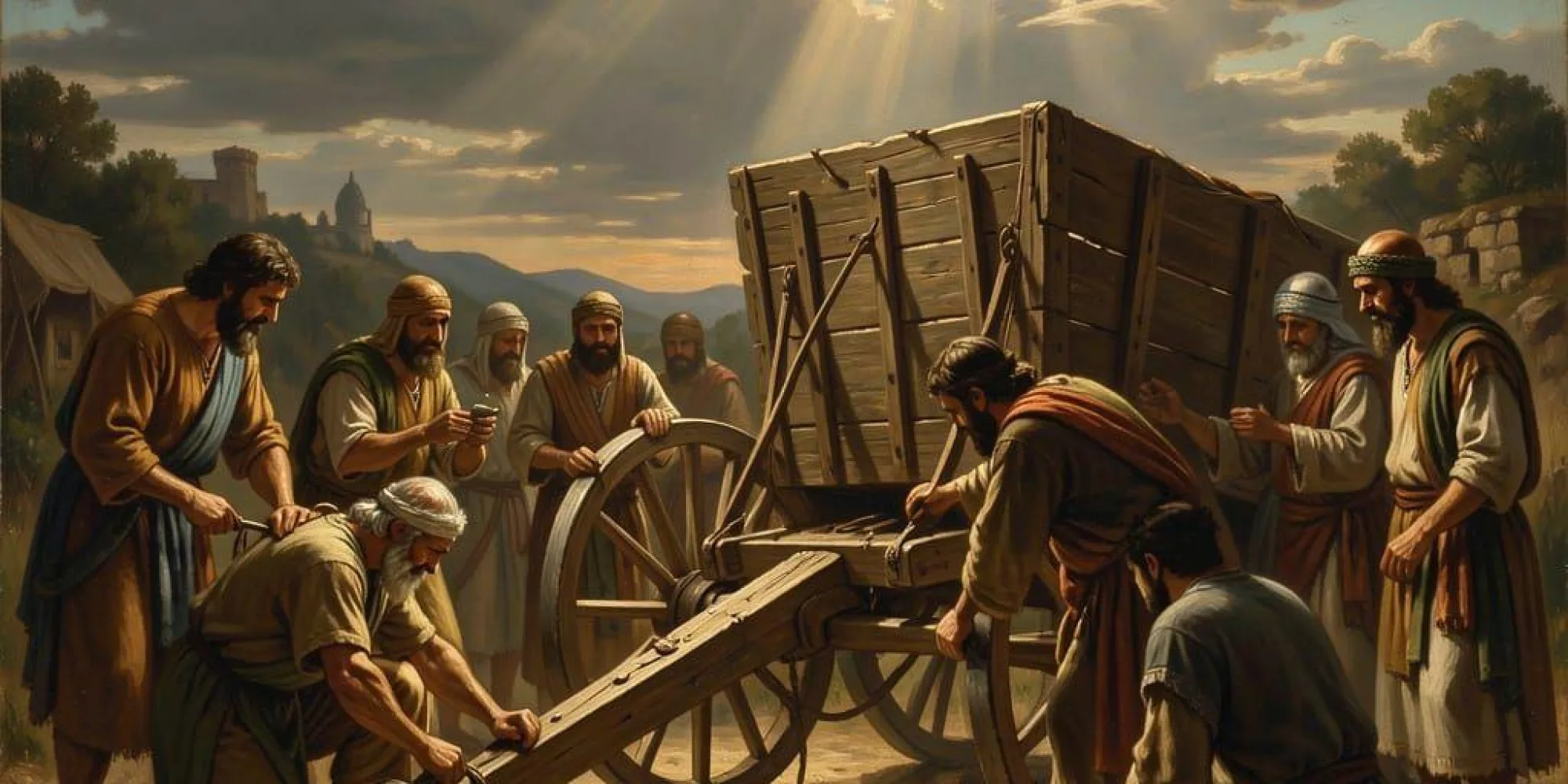
In one episode of The Bible series on Amazon Prime, there’s a tiny scene that sent my mind racing about engineering innovation tipping points — not what the producers were intending, I’m certain. Not long after David is anointed king and brings the Ark of the Covenant to Jerusalem, right before he derails his own life over Bathsheba, a caravan drags itself across a stony desert road. A wooden axle snaps under a wooden cart. Dust, splinters, curses. And instead of thinking about scripture, my mind went straight to my dad and the Peron Dunes.
Tasmania has its own kind of biblical landscapes—not deserts, but the white sand of the Peron Dunes at St Helens. Home of the Peron Dunes Sand Enduro, the oldest off‑road race in Australia. A six‑kilometre loop carved through dunes so soft that even walking fifty feet feels like you’ve run a marathon. The race was the invention of a true Tasmanian tinkerer, Arthur Haywood—one of the first people in the world to bolt four‑wheel‑drive running gear onto V8 Holden sedans. While Americans were bouncing around in those 1970s dune buggies with a flag on a stick, Arthur was lifting full‑size Holden Statesmans into go‑anywhere machines that would make a modern US country boy blush.
My dad raced in that world, and because of his successes on the track he eventually became a life member of the club. In those early years he ran whatever he could get his hands on: VW gearboxes and axles from 1960s and 70s Beetles, Kombis, and the odd VW sedan dragged out of a paddock. The logic was simple. Germans know how to build things, and Porsche drivetrains were a fantasy for hobby off‑road racers, so Volkswagens were the next best thing. But the sand had other ideas.
Those VW gearboxes shattered teeth like two boxers throwing haymakers outside a bar in downtown Boston. And the axles—the axles were the real weak point. The CV joints held on as long as they could, but the dunes always won. Dad spent countless nights rebuilding gearboxes on the shed floor, only to have the sand crack an axle like a toothpick halfway through the next race. And here’s the part that still amazes me: this wasn’t a 1980s problem. This was a three‑thousand‑year‑old problem. The axle has been the eternal failure point of wheeled transport. Ancient chariots broke axles. Roman wagons broke axles. Medieval carts broke axles. Dad’s off‑road racers broke axles. Same problem. Same physics. Same swear words.
You can change the wheels, the suspension, the engines, the metallurgy—but the axle is where physics refuses to negotiate. It’s the one component that must absorb every force at once: vertical load, lateral load, torsion, vibration, shock, rotational shear. It’s the single point where all the violence of movement converges. Which is why a time‑travelling Persian soldier from 500 BC could step into Dad’s shed in 1983, look at a snapped VW axle lying on the concrete, and understand the problem instantly. He wouldn’t recognise the Toyota engine, the roll cage, the fibreglass panels, or the sand tyres. But the axle? The axle he’d know. Same failure mode. Same posture of the mechanic. Same muttered calculations about how far the nearest replacement is. Civilisation changes. Physics doesn’t.
For most of human history, axle technology barely moved. Sumerians broke axles. Egyptians broke axles. Persians broke axles. Romans broke axles. Medieval wheelwrights broke axles. Dad broke axles. It’s one of the cleanest long arcs in engineering: five thousand years of incremental improvement, zero fundamental breakthrough. We built aqueducts, cathedrals, steam engines, railways, skyscrapers, microchips—but the axle stayed stubbornly ancient. A rotating beam under impossible loads. Then, suddenly, everything changed.
In the late 1980s and early 1990s, a cluster of technologies converged: high‑purity alloy steels, CNC machining, finite‑element stress modelling, controlled heat treating, aerospace‑grade bearings, synthetic lubricants, better grain alignment, better metallurgy. And the axle—the eternal failure point—finally became stronger than the forces acting on it. A five‑thousand‑year problem solved in one generation. That’s what a tipping point looks like. Not a gentle slope. A vertical spike. One decade that rewrites the physics of what’s possible.
And that’s when my mind jumped. Not to nostalgia. Not to Dad’s shed. But to Mars. Because if a problem as old as the wheel can collapse in a single decade, then maybe inhabiting Mars isn’t impossible. Maybe going to Mars for lunch and coming back the same day isn’t ridiculous. Maybe the technologies that make it possible aren’t even invented yet. Maybe they’re sitting in the same long plateau the axle sat in—waiting for their moment to converge.
We don’t know what we don’t know. And history suggests that the next breakthrough won’t arrive politely or gradually. It will arrive the way axle technology arrived in the 1990s: suddenly, violently, and with the force of inevitability. Civilisation doesn’t move in a straight line. It moves in long stretches of nothing, followed by a vertical spike that rewrites the rules. The axle took five thousand years. Mars might take eighty. Or twenty. Or ten. Or it might already be in motion, hidden inside technologies we haven’t recognised as part of the same story yet.
That’s the pattern. That’s the physics. That’s the way the world actually changes.

About Jason Bresnehan
Jason writes in a modular, mind‑drift style that moves between business, recovery, faith, anthropology, and the oddities of everyday life without warning or apology. His work blends operator‑grade clarity with sideways narrative turns — the kind that start in a boardroom, drift through Scripture or Tasmanian riverbanks, and land in a piece of doctrine you didn’t see coming.
He has spent years helping organisations and people get unstuck, and his writing reflects the same instinct: take something messy, name it cleanly, and make it usable. His pieces — whether on addiction, Catholic symbolism, business operators, or human quirks — aren’t lectures. They’re field notes. Observations. Fragments designed for real people in real moments, including the tired executive delayed in an airport lounge at 11:45pm.
Jason publishes micro‑chapters as he writes them — standalone pieces that don’t follow a cadence or a theme. They accumulate over time into a larger body of work, shaped by curiosity, faith, operator discipline, and a refusal to perform — just get outcomes.
Founder of the Hadspen Foundation, Jason is committed to building frameworks for spiritual recovery that are both repeatable and personal. His writing is guided by discernment, narrative cadence, and the belief that doctrine should support—not overshadow—the human story.