
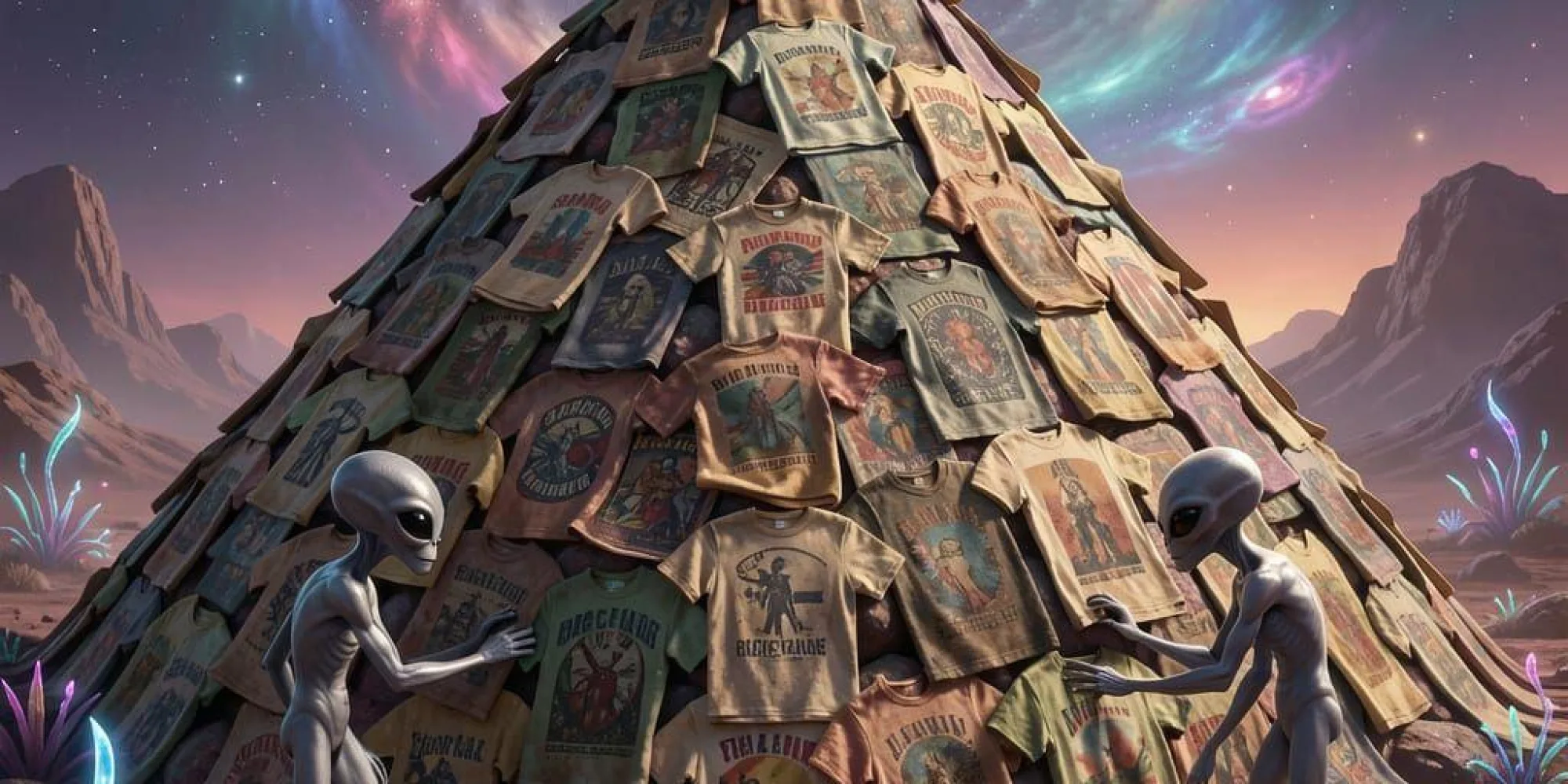
Ancient Cotton Monuments
There is something so American that Americans barely see it anymore, but to an Australian it glows like a flashing hazard sign at sea. That thing is the screen‑printed T‑shirt.
America is the only country where every event becomes cotton. If something happened, might have happened, was reported on cable news, or someone once strongly believed happened, there will be a T‑shirt. Political rallies, charity runs, church picnics, missing pets, missing people, murder victims, tornadoes, conspiracy theories, bachelor parties, school fundraisers, dog birthdays and anniversaries of national tragedy all end up flattened, inked, and sold. This isn’t fashion. It’s how America records history when a monument feels like overkill.
In Australia, a T‑shirt is clothing. You wear it to mow the lawn, paint the shed, or because all your clean shirts are in the wash. In America, the T‑shirt is a national storytelling device. It says who you are, what you stood for, where you were, and what you’d like strangers to know about you before you speak. It is a wearable footnote that says this meant something, and so do I.
The modern screen‑printed T‑shirt arrived alongside two deeply American publishing events in 1939. One was the Wizard of Oz logo printed on thick cotton, announcing that stories could now be worn. The other was the first publication of the Alcoholics Anonymous Big Book, printed on unusually heavy paper so it could survive being dropped, clenched, reread, and clutched by people who needed something solid to hold onto. It was nicknamed the Big Book not for ambition, but for weight. America trusts objects. If something matters, you should be able to grip it.
The screen‑printed T‑shirt soon became the country’s most efficient cultural multi‑tool. It can be sincere, ironic, earnest, sarcastic, self‑deprecating, grim, cheerful, tragic, or funny, sometimes all at once. “I went to the Greek Islands and all I got was this lousy T‑shirt” isn’t really a joke about travel. It’s a membership badge that says I was there, I get the joke, and I’m still in.
This chapter fell into place the moment I saw a “Who Is D.B. Cooper?” T‑shirt and felt my brain slide sideways. Why does a shirt need to ask that question, and who on earth is it aimed at? D.B. Cooper hijacked a commercial airliner in 1971, demanded money and parachutes, then jumped out of the plane somewhere over the Oregon wilderness and vanished forever. Fifty years later, someone is selling cotton shirts emblazoned with a police sketch done in three pencil shades and no resolution whatsoever.
Who buys the D.B. Cooper shirt? Almost certainly a seventy‑year‑old man visiting Oregon who remembers the news bulletin. He remembers an America before airport security became ceremonial theatre. He remembers walking onto planes like boarding a bus, wearing a tie, lighting a cigarette, and taking a sip from a whisky flask without anyone panicking. He remembers when hijackings were new and the word frontier still felt aspirational. For fifteen dollars — not much more than an airline ticket cost back then — he buys nostalgia, identity and a mystery that never needed solving. It’s not a shirt. It’s a memory you can fold.
Once you accept that logic, the American–Australian difference becomes obvious if you do what every grizzled TV detective does when confused and follow the money. America is built on myth‑making, merchandising, mass production, and turning moments into objects. Australia is built on understatement, suspicion of effort, and an automatic allergy to anything that looks like it’s taking itself seriously.
If an Australian family printed T‑shirts for Uncle Sean’s wake, the conversation would stop dead and someone would quietly say, “Alright, mate, that’s enough.” In America, they’d print two hundred, sell them at the door, and if the organisers were on their game there’d be matching coffee mugs and possibly a commemorative hoodie.
The D.B. Cooper shirt is America in one object. A decades‑old crime, a police sketch, a price tag, a tourist impulse and a myth squashed into cotton. Take a story, make it portable, sell it. People buy it because it lets them participate in the myth without needing conclusion, nuance, or restraint.
This isn’t really about T‑shirts. It’s about cultural operating systems. In America, myth plus capitalism equals merchandise. Memory plus identity equals purchase. Event plus emotion equals screen print. It’s the same engine that produces MAGA hats, “I Survived Hurricane Andrew” shirts, “Area 51 Fun Run” shirts, “World’s Best Grandpa” shirts, school reunion shirts and theme park souvenirs that exist purely to say this mattered and so did I.
Just as I finished reconciling all this, a documentary added another layer of insanity. The camera cut to a D.B. Cooper–themed bar, not even in Oregon but in Washington State. I could immediately see the whiteboard, the coloured Post‑it notes, and the founders pitching ideas. Dinosaurs. Too childish. Explorers. Too obvious. Someone says D.B. Cooper. Who? Exactly.
If you opened a Ned Kelly–themed bar in Australia, opening night would end with half‑cut welders wearing metal buckets on their heads, eye slits cut with an angle grinder, treating the place as a challenge rather than a tribute. In Australia, myth isn’t merchandise. Myth is an invitation to take the piss. It exists to be mocked, bent, ruined, or weaponised for mischief by a bloke named Dazza doing the worst accent you’ve ever heard.
Americans lean into the theme. Australians lean against it. One builds monuments in cotton. The other kicks them over for sport. Neither culture is sensible. Both are completely predictable.
In a million years, when aliens from Planet Ork sift through the fossil record trying to reconstruct what we were like, screen‑printed T‑shirts will puzzle them the most. They’ll find cotton announcing hurricanes, murders, mysteries, jokes, reunions and conspiracies, all treated with identical ritual seriousness. They’ll conclude this species processed meaning by printing it on fabric and wearing it until it faded.
Which, in fairness, isn’t a bad summary.

About Jason Bresnehan
Jason writes in a modular, mind‑drift style that moves between business, recovery, faith, anthropology, and the oddities of everyday life without warning or apology. His work blends operator‑grade clarity with sideways narrative turns — the kind that start in a boardroom, drift through Scripture or Tasmanian riverbanks, and land in a piece of doctrine you didn’t see coming.
He has spent years helping organisations and people get unstuck, and his writing reflects the same instinct: take something messy, name it cleanly, and make it usable. His pieces — whether on addiction, Catholic symbolism, business operators, or human quirks — aren’t lectures. They’re field notes. Observations. Fragments designed for real people in real moments, including the tired executive delayed in an airport lounge at 11:45pm.
Jason publishes micro‑chapters as he writes them — standalone pieces that don’t follow a cadence or a theme. They accumulate over time into a larger body of work, shaped by curiosity, faith, operator discipline, and a refusal to perform — just get outcomes.
Founder of the Hadspen Foundation, Jason is committed to building frameworks for spiritual recovery that are both repeatable and personal. His writing is guided by discernment, narrative cadence, and the belief that doctrine should support—not overshadow—the human story.